
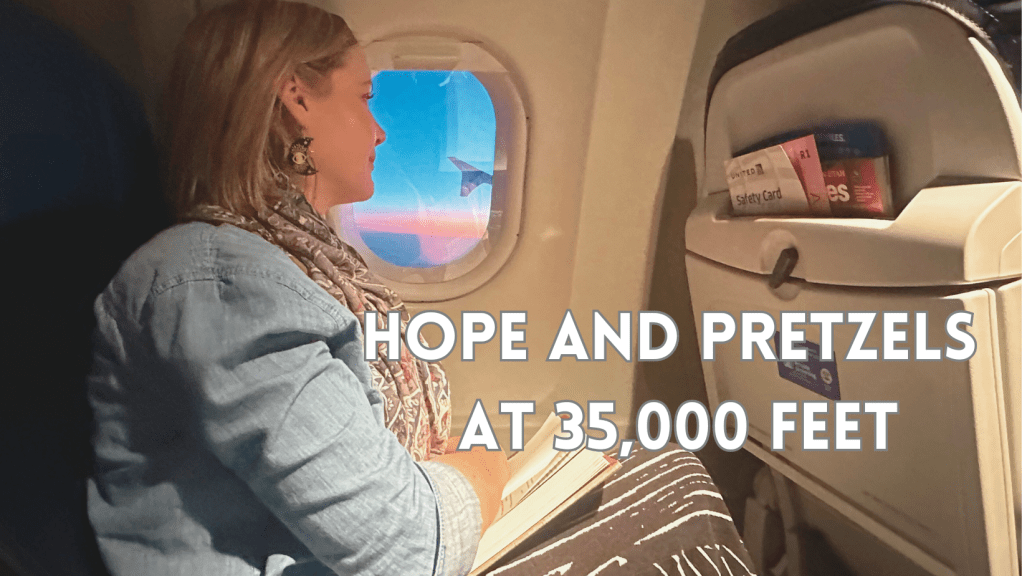
Photo By the Kind Stranger in Row 32, Seat C Who Reminded Me to Take Up Space
At first, it felt like any other flight. In order to avoid snowy weather in Chicago, the boarding process began early, as the pilot intended to depart about 15 minutes ahead of schedule.
As I made my way to my window seat, the other woman seated in my row looked about my age, dressed in a way that made me think that we could be friends. But I didn’t engage. I had my Airpods in, the book “Courage is Calling” by Ryan Holiday in hand, and was just ready to get home. No one filled the seat between us, so as my row mate lowered the middle tray table to set down her Dunkin Donuts beverage, I didn’t judge, but I noticed.
It was upon take off (middle tray table temporarily secured back into place) that I realized this flight was different from others. I was aware that the Pentagon was close to the airport, but as its distinct shape caught my eye from the sky, I got giddy excited. After an evening and two early mornings exploring as much of Washington, D.C. as possible, it’s hard not to grow an increased sense of protectiveness over this sacred place. It’s impossible to stand on the steps of the Capitol Building, and not think about the deadly insurrection that took place less than three years ago. As I flew over the Pentagon, I remembered seeing the smoke, structural damage and 184 lives lost after terrorists crashed a plane into the building on 9-11.
In both cases, I felt a sense of our resilience as a nation… a very imperfect nation, but a resilient nation, made up of resilient people.
The rest of the flight was spent chasing the sunset westward. I couldn’t take my eyes off it, especially not the deepest red band where the light met the cloud line. I was reminded of a common teaching in mindfulness and meditation that our minds are like the limitless sky and our thoughts like the clouds… impermanent, changing. As I continued this practice of mindfulness and awe, staring out the window, one passing cloud in my mind was the thought of my Dad, who loved the sky, flying, and clouds. With my gaze fixed on the horizon, I started to notice the feeling of overwhelm in my body. My heart began to race, and as a teacher of self-regulation, mindfulness and breath work, I fell back on my training.
When I teach breath work at the law enforcement academy level, I’ll often suggest to recruits not to wait until things are going wrong to practice breath work. Practice it when things are going well. When it’s a sunny day and the windows are down and your favorite song is on, practice straw breathing then. Try to take a moment of joy and make it better by connecting to your breath. So I did just that. Staring at the sunset, I began to breathe in for a count of four, and out for a count of eight.
With just a few rounds of straw breathing, my heart rate started to come back down, and I asked myself another question… a question I don’t think we ask ourselves often enough: “Is there anything I can do right now to make this moment even better?”
I was hungry. Earlier I’d been debating whether I should eat the trail mix in my backpack on the first flight, try to grab a bite at O’Hare during my layover, or wait until my flight to Indianapolis, and eat the trail mix then. None of those sounded particularly appealing, let alone joyful.
But when I asked myself that question: “Is there anything I can do right now to make this moment even better?,” I remembered that in my backpack, down at my feet, I had a double Wawa pretzel.
As a kid, I’d get so excited whenever soft pretzels would make it home from the grocery store, and I’ve been Team Soft Pretzel ever since. Earlier this year, when visiting my best friend Kristen in Philadelphia, she introduced me to the Wawa pretzel. This convenience store delicacy captured my heart to the point that I brought 10 pretzels home from Philly. As we were moving stuff around from my backpack to my suitcase to try to accommodate all of the pretzels, so much effort went into getting the suitcase to close and zip that it partly ripped. Oops!
So I was thrilled to be reunited with Wawa pretzels in D.C., and even more excited about having a double for dinner while chasing the sunset.
You have to understand, a Wawa pretzel, especially a double, is not a dainty thing. Wawa pretzels are large and in charge. So as I pulled out this treat and began to tear off bite after bite, I started to eye the lowered tray table of the unoccupied seat next to me. Besides good manners, I don’t know why I asked “Do you mind if I share this with you?” to the other woman in my row because I knew I didn’t need to. This extra space was a gift to both of us and belonged to neither of us. Of course she said “sure!”, and I happily plopped down my massive pretzel/dinner, reaching over for bites while staring at the sky. Then, as I wrestled my water bottle out of the seat pocket in front of me, I set it down in the empty seat.
I was so grateful to my row mate for reminding me that I was allowed to take up space. Especially on planes, I try to be the smallest, quietest version of myself. Mostly, again, because of manners, but this spreading out felt like another big exhale. The pretzel on the tray table and my water bottle on the seat next to me brought me joy. That might sound weird about a water bottle, but it was true.
Because of its heft, I left my “comfort” YETI water bottle at home, but I brought a Strength Card sticker with me to place on the disposable bottle. This was for two reasons: to remind me to be courageous as I embarked on a new adventure, but more practically it was to incentivize me to make sure that it was the one and only bottle of water I used on the trip. While I love to take up space – physical, emotional, proverbial, etc. – I do not want that space I’m taking to be a footprint of plastic and waste on our planet.
With a nourished soul and belly, and a time to just “be” and reflect over the previous couple of days. I was able to feel more deeply into why I had been in a somber mood, a mood that made me feel like I wasn’t showing enough gratitude for the incredible opportunity that I’d been given, which in turn, made me feel worse.
I had mentioned to a couple of friends that I was feeling lonely on Monday night, despite having spent the morning doing whatever I wanted, and the afternoon around a group of people who are all working to make the world a better place. But what I was feeling wasn’t loneliness. I’m by myself quite a bit, actually, and don’t mind it at all. I then correctly identified what I was feeling as melancholy.
In an essay I wrote earlier this year about my travel anxiety (we’re coming full circle), I mentioned Brené Brown’s important point that in order to access the support you truly need, you have to identify what you are really feeling. Loneliness might be helped by reaching out to a friend or a phone call with my Mom. Brown talks about the feeling of “bittersweet” in a March 2022 Facebook post and said that her “bittersweet state of mind is not about perpetual sadness or melancholy. In fact, it is the source of my joy, my gratitude, and my hope. I have a very clear understanding of pain and sorrow and loss, and the reverence I have for what is hard makes what is sweet and good in life even sweeter. These dichotomies – joy through sorrow, hope through struggle – are the crux of bittersweet”.
I was in Washington, D.C. with an invitation to participate in visioning exercises and discussion on how to expand something I’m REALLY excited about, the Science of Hope, to the law enforcement and public safety communities. The Science of Hope aligns with every aspect of wellness and resilience building that I study, believe in, and do my best to support or offer my colleagues in public safety and beyond, including Critical Incident Stress Management (CISM), Mental Health First Aid, QPR (Question Persuade Refer) Suicide Awareness and Prevention, Crisis Intervention Training, Brain Science (Science of Stress), Breathwork, Mindfulness Meditation, and Yoga. And more. It aligns with all of it.
A thread that runs through all of these modalities of wellness is trauma, including trauma resilience, trauma mitigation, trauma recovery and trauma healing.
And without fail, each time I take a deep dive into these or related topics, it has a tendency to kick up a lot of dust. Having endured a series of three cumulative traumatic events as a teenager, more in my early political career, and the exposure to over a decade of secondary trauma working in public safety, I am a trauma survivor. But I’m also a post-traumatic thriver.
So as I work with individuals and groups – locally and throughout the world – to help others recover from traumatic experiences, I feel sadness for my teenage self who desperately needed this help, even though our current understanding of trauma had been far from developed, yet so grateful for the practices and resources that I did have and find. I feel anger for the decades of damaged and misplaced self-worth I carried around, and gratitude for the person I am today. I feel devastated for the history of unaddressed and ongoing trauma that has effected humanity for the worst (war, genocide, slavery), and I’m grateful that we are starting to understand trauma and its effects on a medical, psychological, personal, relational and societal level. And while my heart breaks for so many people who have faced trauma much more severe than mine, I’m grateful to be in a position where I might be able to help even just one other person.
Working with trauma is not easy. It is not for the faint of heart. I keep visual reminders of courage and strength nearby because I need them to do this work.
Earlier in the day, as I was packing my bags for a day full of meetings and the eventual flights home, the zipper of my suitcase broke completely. I called the front desk to ask if they had any duct tape. They did, and brought it to my room. I then wrapped duct tape a few times around the center of my suitcase, placed a few pieces at the bottom, and carried on. Eventually, I bought a luggage strap to replace the duct tape around the center, but kept the tape at the bottom for fear of something shifting and spilling out.
As I stared out at the enduring sunset, I felt there was a lot in common with my busted, taped-up suitcase, still sufficiently rolling around the city and protecting my belongings, and the work I do to help others find their path to trauma healing while managing the messy and non-linear path of my own. But while my suitcase’s scars were visible, the scars of trauma are often invisible.
Almost everyone has some trauma. Some people more than others. Some more apparent than others. But that’s why it’s so important to understand. When we begin the brave and courageous efforts to examine and lean into our own trauma (if you are reading this, I hope it’s not that much), we can gain a sense of compassion for almost every other person around us, even those who have wronged us. Trauma work is bittersweet… filled with so much sorrow and so much joy, so much struggle and so much hope.
A natural response to trauma is hiding away from the world and withdrawing from the people we love. And yet, some of the best ways to build resilience to and recover from trauma is to stay connected to the people who matter to us (hint: strangers can matter, too). That’s because trauma affects us all, to one degree or another. None of us are in this alone, and though we may have to summon all the strength and courage we can muster, there are many resources available for help.
As we neared Chicago, and I was writing this essay in my head, I knew what would be the perfect picture. But I couldn’t do it by myself. Still inspired by her own taking of space, I asked my row mate for a favor. I said: “I’m a writer and I’m working on a story about this very moment. Would you please take a picture of me leaning against the window?” She was happy to do it, and as she did, she also marveled at the sunset as it showed up on camera through the plane window.
The final moments of the flight were bumpy, but I reminded myself of the impermanent nature of the weather. I noticed our plane weaving in and out of clouds, and thought that no one wanted to avoid turbulence as much as the guy flying this thing.
Clouds are inevitable. Weather is inevitable. Pain is inevitable. Sorrow is inevitable. But limitless compassion is possible. Healing is possible. Connection is possible. Hope is possible. Joy is possible.
 By Katie Carlson
Katie, thank you for a thoughtful, vulnerable, authentic piece. Many, unfamiliar with mindfulness and meditation, could find it instructional and curiosity-provoking. We always have the tools of mindfulness even at 35,000 ft.
LikeLike
Thank you for Your insight to trauma and sharing your story. This is so inspiring. I am grateful for the yoga at Garfield park and as a teacher I do brain breaks involving yoga periodically. From this article and your insight on trauma I may use it more. Seems like my students are coming in with more trauma every school year.
LikeLike
Thank you so much for the comment and feedback. I feel so grateful to be able to share from my experience and share this work with others. In Hope Science, they often say that it can just take one person in someone’s life to give them hope. I know your students are lucky to have you.
LikeLike