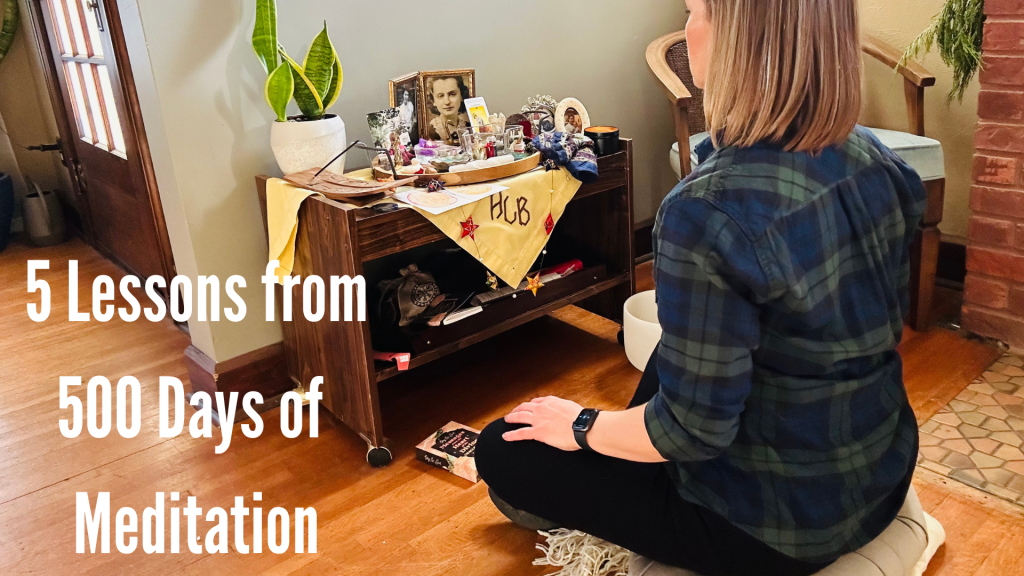
5 Lessons from 500 Days of Meditation

I’ve been waiting to write about meditation. First, I passed the point of 100 consecutive days, and though the benefits of the daily practice were practically bursting out of me, I thought that 100 days wasn’t impressive enough. I’ll share at the one year mark, I thought.

The one year mark came and went amidst a lot of chaos, chaos that was softened by leaning heavily on my meditation practice. But with no time to write about it.

But on December 12, 2023, I hit 500 days of consecutive meditation practice! 

Mindfulness meditation practice has made a huge impact on my life, but I’m going to boil what I’ve learned over 500 consecutive days of meditation down to 5 lessons.

  1. Be Your Own Biggest Cheerleader. If there is one biggest impact that mindfulness meditation practice has had on my life, it’s this. I spent decades of my life beating myself up. Whether it be harshly judging my actions and/or my appearance, or comparing myself to others, I was not nice to me. But in meditation practice, there’s an opportunity to change that running narrative. Sometimes people think that meditation is about being able to concentrate for a certain amount of time without being distracted, so they think they “aren’t good at it”. But meditation is about recognizing when your mind wanders, and gently, with kindness toward yourself, bringing your attention back. That sense of kindness toward myself… replacing the “Katie, you suck at this” with “That’s okay! Just bring your attention back!” seeped into the rest of my self-talk. Over time, I’ve gone from my own worst critic, to my own biggest cheerleader, and the cheer is: “It’s okay! Keep going!”
  1. Show Up for Yourself. Sometimes self-care is described as “putting on your own oxygen mask first”, which is apt, especially if you frequently put the needs of others above your own, or are pouring from an empty cup. But the truth is that service to others isn’t the only reason that we don’t give ourselves the self-care we need. Stress and overwhelm can make us forget about our true capacity to show up for ourselves. We may also forget that showing up for ourselves doesn’t have to mean finding an hour to take a yoga class, or a twenty minute meditation. My teacher, Fleet Maull, taught that in mindfulness, we must “take our seat”. That may mean taking our seat on an actual meditation cushion, but it also just means showing up, and arriving at your practice. The secret is that even if you just show up for yourself for one minute, or five minutes, “It’s okay!” (see above). 
  1. Just Breathe. Our breath is so important. When we can control nothing else around us, we can control our breath. And while we’re lucky that we don’t have to think about each breath we take, our bodies SAVOR the intentional assistance with our breath. There is a lot of anatomy and neuroscience behind breath work, and why it’s so effective, but I’m not going to rehash that here. But I joke as I’m teaching breath work, yoga, mindfulness, meditation, and other resilience practices to public safety personnel, “Have you noticed that we are mostly just breathing?!” As you read this sentence, take three big, deep breaths. Then notice how you feel. Your body and mind will thank you.
  1. Actively Direct Your Energy. This might tie with softening my self-talk for the biggest impact that mindfulness has had on my life. Or they just go hand-in-hand. It’s pretty simple, actually. We can passively let life happen to us, or we can make choice after choice after choice to spend our energy on the things that are important to us. But first, it helps to be crystal clear about what’s important to you. Make a list. Mine is something like: family, friends, my dog OkeDoke, my personal health and self-care, my work, my hobbies (like climbing and teaching), serving my community, my relationship with God, and all people, beings, and things. Then make another list. What gets in the way of those things that are important in your life? We practice mindfulness meditation not so we can qualify for the Best Meditator Ever Award, but so we can strengthen our muscle of mindfulness – that noticing of when our mind has wandered, and gently bringing it back – so that we can live our lives with our energy and attention directed at the things that really matter. Recognize what distracts you (phones, meaningless drama, bad habits, etc.), and direct your attention and energy back to the things on this first list. And guess what! If you get distracted, and have to start over, “It’s okay!”
  1. You Can Always Start Again. As the Japanese proverb, and many other iterations go, “Fall down seven times, and get up eight.” Whether you’re directing your attention during a five minute guided meditation practice, or implementing a new self-care routine, it doesn’t matter how many times you have to start over, as long as you start over. It’s totally okay.

Bonus: Some of my favorite authors, like Gretchen Rubin and James Clear, write about “habit stacking”, one of the most useful methods I’ve used to implement healthy habits. So while I hope to have convinced you to consider adding a mindfulness meditation practice to your life, think about what you are already doing. Do you pull into a certain parking spot each day? Stack a 1 minute mindfulness practice onto parking. But another option is this: Stack your mindfulness practice with a gratitude practice and/or prayer. They go hand in hand. And I won’t promise much, but I’ll promise this. You’ll never regret taking three big breaths and listing three things you are grateful for.

Start small, folks. My meditation practice took many years, many 21 Day Challenges, many courses, many articles, many apps, and a 300 Hour Meditation Teacher Training to develop – not to mention the past 500 (!) days – and I get distracted during meditation ALLLLLLL THE TIME. I’m always interested in deepening my practice, including extending the length of the practice. But the current length (about 20 minutes daily, followed by gratitude and intention setting) is one that fits well into my morning routine, and is something that I can maintain. It’s been encouraged that I participate in annual silent mindfulness meditation retreats and everything inside of me pouts, “But I don’t wanna”. My practice has lots of room to grow, but for now, it is where it is and that’s okay.

I’m endlessly grateful for the people and organizations who have helped me develop this practice. It started with the Center for Mindfulness in Public Safety, including my teachers and friends Dr. Fleet Maull, Vita Pires, John MacAdams, Julie Paquette, and Robert Ohlemiller. I completed my 300 Hour Mindfulness and Meditation Teacher Training through the Engaged Mindfulness Institute, with the same amazing people listed above.
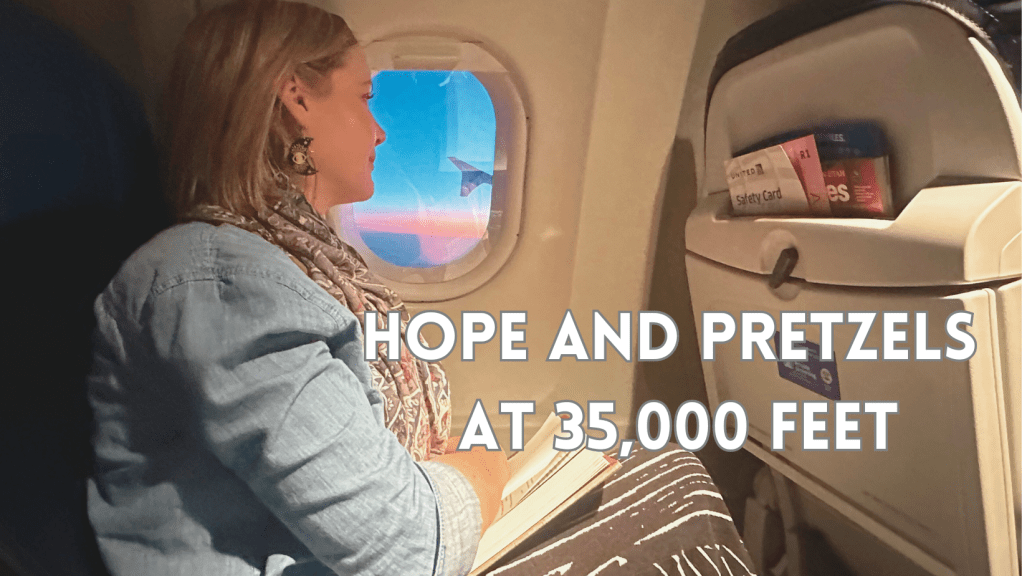
Hope and Pretzels at 35,000 Feet

Photo By the Kind Stranger in Row 32, Seat C Who Reminded Me to Take Up Space

At first, it felt like any other flight. In order to avoid snowy weather in Chicago, the boarding process began early, as the pilot intended to depart about 15 minutes ahead of schedule.

As I made my way to my window seat, the other woman seated in my row looked about my age, dressed in a way that made me think that we could be friends. But I didn’t engage. I had my Airpods in, the book “Courage is Calling” by Ryan Holiday in hand, and was just ready to get home. No one filled the seat between us, so as my row mate lowered the middle tray table to set down her Dunkin Donuts beverage, I didn’t judge, but I noticed.

It was upon take off (middle tray table temporarily secured back into place) that I realized this flight was different from others. I was aware that the Pentagon was close to the airport, but as its distinct shape caught my eye from the sky, I got giddy excited. After an evening and two early mornings exploring as much of Washington, D.C. as possible, it’s hard not to grow an increased sense of protectiveness over this sacred place. It’s impossible to stand on the steps of the Capitol Building, and not think about the deadly insurrection that took place less than three years ago. As I flew over the Pentagon, I remembered seeing the smoke, structural damage and 184 lives lost after terrorists crashed a plane into the building on 9-11. 

In both cases, I felt a sense of our resilience as a nation… a very imperfect nation, but a resilient nation, made up of resilient people.

The rest of the flight was spent chasing the sunset westward. I couldn’t take my eyes off it, especially not the deepest red band where the light met the cloud line. I was reminded of a common teaching in mindfulness and meditation that our minds are like the limitless sky and our thoughts like the clouds… impermanent, changing. As I continued this practice of mindfulness and awe, staring out the window, one passing cloud in my mind was the thought of my Dad, who loved the sky, flying, and clouds. With my gaze fixed on the horizon, I started to notice the feeling of overwhelm in my body. My heart began to race, and as a teacher of self-regulation, mindfulness and breath work, I fell back on my training. 

When I teach breath work at the law enforcement academy level, I’ll often suggest to recruits not to wait until things are going wrong to practice breath work. Practice it when things are going well. When it’s a sunny day and the windows are down and your favorite song is on, practice straw breathing then. Try to take a moment of joy and make it better by connecting to your breath. So I did just that. Staring at the sunset, I began to breathe in for a count of four, and out for a count of eight. 

With just a few rounds of straw breathing, my heart rate started to come back down, and I asked myself another question… a question I don’t think we ask ourselves often enough: “Is there anything I can do right now to make this moment even better?”

I was hungry. Earlier I’d been debating whether I should eat the trail mix in my backpack on the first flight, try to grab a bite at O’Hare during my layover, or wait until my flight to Indianapolis, and eat the trail mix then. None of those sounded particularly appealing, let alone joyful.

But when I asked myself that question: “Is there anything I can do right now to make this moment even better?,” I remembered that in my backpack, down at my feet, I had a double Wawa pretzel.

As a kid, I’d get so excited whenever soft pretzels would make it home from the grocery store, and I’ve been Team Soft Pretzel ever since. Earlier this year, when visiting my best friend Kristen in Philadelphia, she introduced me to the Wawa pretzel. This convenience store delicacy captured my heart to the point that I brought 10 pretzels home from Philly. As we were moving stuff around from my backpack to my suitcase to try to accommodate all of the pretzels, so much effort went into getting the suitcase to close and zip that it partly ripped. Oops!

So I was thrilled to be reunited with Wawa pretzels in D.C., and even more excited about having a double for dinner while chasing the sunset.

You have to understand, a Wawa pretzel, especially a double, is not a dainty thing. Wawa pretzels are large and in charge. So as I pulled out this treat and began to tear off bite after bite, I started to eye the lowered tray table of the unoccupied seat next to me. Besides good manners, I don’t know why I asked “Do you mind if I share this with you?” to the other woman in my row because I knew I didn’t need to. This extra space was a gift to both of us and belonged to neither of us. Of course she said “sure!”, and I happily plopped down my massive pretzel/dinner, reaching over for bites while staring at the sky. Then, as I wrestled my water bottle out of the seat pocket in front of me, I set it down in the empty seat.

I was so grateful to my row mate for reminding me that I was allowed to take up space. Especially on planes, I try to be the smallest, quietest version of myself. Mostly, again, because of manners, but this spreading out felt like another big exhale. The pretzel on the tray table and my water bottle on the seat next to me brought me joy. That might sound weird about a water bottle, but it was true. 

Because of its heft, I left my “comfort” YETI water bottle at home, but I brought a Strength Card sticker with me to place on the disposable bottle. This was for two reasons: to remind me to be courageous as I embarked on a new adventure, but more practically it was to incentivize me to make sure that it was the one and only bottle of water I used on the trip. While I love to take up space – physical, emotional, proverbial, etc. – I do not want that space I’m taking to be a footprint of plastic and waste on our planet.

With a nourished soul and belly, and a time to just “be” and reflect over the previous couple of days. I was able to feel more deeply into why I had been in a somber mood, a mood that made me feel like I wasn’t showing enough gratitude for the incredible opportunity that I’d been given, which in turn, made me feel worse.

I had mentioned to a couple of friends that I was feeling lonely on Monday night, despite having spent the morning doing whatever I wanted, and the afternoon around a group of people who are all working to make the world a better place. But what I was feeling wasn’t loneliness. I’m by myself quite a bit, actually, and don’t mind it at all. I then correctly identified what I was feeling as melancholy. 

In an essay I wrote earlier this year about my travel anxiety (we’re coming full circle), I mentioned Brené Brown’s important point that in order to access the support you truly need, you have to identify what you are really feeling. Loneliness might be helped by reaching out to a friend or a phone call with my Mom. Brown talks about the feeling of “bittersweet” in a March 2022 Facebook post and said that her “bittersweet state of mind is not about perpetual sadness or melancholy. In fact, it is the source of my joy, my gratitude, and my hope. I have a very clear understanding of pain and sorrow and loss, and the reverence I have for what is hard makes what is sweet and good in life even sweeter. These dichotomies – joy through sorrow, hope through struggle – are the crux of bittersweet”.

I was in Washington, D.C. with an invitation to participate in visioning exercises and discussion on how to expand something I’m REALLY excited about, the Science of Hope, to the law enforcement and public safety communities. The Science of Hope aligns with every aspect of wellness and resilience building that I study, believe in, and do my best to support or offer my colleagues in public safety and beyond, including Critical Incident Stress Management (CISM), Mental Health First Aid, QPR (Question Persuade Refer) Suicide Awareness and Prevention, Crisis Intervention Training, Brain Science (Science of Stress), Breathwork, Mindfulness Meditation, and Yoga. And more. It aligns with all of it.

A thread that runs through all of these modalities of wellness is trauma, including trauma resilience, trauma mitigation, trauma recovery and trauma healing.

And without fail, each time I take a deep dive into these or related topics, it has a tendency to kick up a lot of dust. Having endured a series of three cumulative traumatic events as a teenager, more in my early political career, and the exposure to over a decade of secondary trauma working in public safety, I am a trauma survivor. But I’m also a post-traumatic thriver.

So as I work with individuals and groups – locally and throughout the world – to help others recover from traumatic experiences, I feel sadness for my teenage self who desperately needed this help, even though our current understanding of trauma had been far from developed, yet so grateful for the practices and resources that I did have and find. I feel anger for the decades of damaged and misplaced self-worth I carried around, and gratitude for the person I am today. I feel devastated for the history of unaddressed and ongoing trauma that has effected humanity for the worst (war, genocide, slavery), and I’m grateful that we are starting to understand trauma and its effects on a medical, psychological, personal, relational and societal level. And while my heart breaks for so many people who have faced trauma much more severe than mine, I’m grateful to be in a position where I might be able to help even just one other person.

Working with trauma is not easy. It is not for the faint of heart. I keep visual reminders of courage and strength nearby because I need them to do this work.

Earlier in the day, as I was packing my bags for a day full of meetings and the eventual flights home, the zipper of my suitcase broke completely. I called the front desk to ask if they had any duct tape. They did, and brought it to my room. I then wrapped duct tape a few times around the center of my suitcase, placed a few pieces at the bottom, and carried on. Eventually, I bought a luggage strap to replace the duct tape around the center, but kept the tape at the bottom for fear of something shifting and spilling out. 

As I stared out at the enduring sunset, I felt there was a lot in common with my busted, taped-up suitcase, still sufficiently rolling around the city and protecting my belongings, and the work I do to help others find their path to trauma healing while managing the messy and non-linear path of my own. But while my suitcase’s scars were visible, the scars of trauma are often invisible.

Almost everyone has some trauma. Some people more than others. Some more apparent than others. But that’s why it’s so important to understand. When we begin the brave and courageous efforts to examine and lean into our own trauma (if you are reading this, I hope it’s not that much), we can gain a sense of compassion for almost every other person around us, even those who have wronged us. Trauma work is bittersweet… filled with so much sorrow and so much joy, so much struggle and so much hope.

A natural response to trauma is hiding away from the world and withdrawing from the people we love. And yet, some of the best ways to build resilience to and recover from trauma is to stay connected to the people who matter to us (hint: strangers can matter, too). That’s because trauma affects us all, to one degree or another. None of us are in this alone, and though we may have to summon all the strength and courage we can muster, there are many resources available for help.

As we neared Chicago, and I was writing this essay in my head, I knew what would be the perfect picture. But I couldn’t do it by myself. Still inspired by her own taking of space, I asked my row mate for a favor. I said: “I’m a writer and I’m working on a story about this very moment. Would you please take a picture of me leaning against the window?” She was happy to do it, and as she did, she also marveled at the sunset as it showed up on camera through the plane window.

The final moments of the flight were bumpy, but I reminded myself of the impermanent nature of the weather. I noticed our plane weaving in and out of clouds, and thought that no one wanted to avoid turbulence as much as the guy flying this thing.

Clouds are inevitable. Weather is inevitable. Pain is inevitable. Sorrow is inevitable. But limitless compassion is possible. Healing is possible. Connection is possible. Hope is possible. Joy is possible.

The Joy of Falling

The sport is indoor rock climbing without rope, or bouldering, but I’m just going to call it climbing.

It wasn’t something I had been longing to do. I had heard of North Mass Boulder, but mostly because I would hear yoga friends talk about yoga classes there. I really had no inclination to go.

But my friend Meg had mentioned it a few times, and offered to take me as a guest. We made plans to attend a yoga class and then climb. 

When I arrived at the gym, my eyes must have looked like a kid in a candy store. During the yoga class, all I could think was, “I can’t wait to climb”. And when we almost didn’t because Meg had a lot of school work to attend to and hadn’t brought her climbing shoes, I momentarily panicked. But we both rented shoes, and at the completion of my first, beginner-level route, I was hooked. 

Over the several months I’ve been climbing, the list of reasons why I love it keeps growing.

The first reason I fell in love with it was that it felt like pure play. It still does. As a kid, there wasn’t a tree, or a combine, an attic stair I wasn’t eager to traverse. Other than emergency preparedness in the chance that I should have to hang onto a bridge or the side of a building to save my life, there’s not much of a point, other than play.

The second reason that I fell in love with it is that I was good at it! I could feel the advantage of my long time yoga practice, my strength, and my flexibility. I felt confident in my body positioning and movement. That if I reach my arm out here, or my leg out there, that it would get me where I needed to go. The more I climb, the more my own body and strength amazes me. At first, I couldn’t believe that I could push the weight of my entire body up by balancing on the ball of my foot on a hold smaller than a tape measure. For most of my life, I’d been doling myself out a lot of body shame and criticism, so this new found sense of body amazement was a welcome change in self talk.

The third reason I fell in love with climbing surprised me. It’s not uncommon to appreciate the “good” pain of a run or workout. But most days, I leave the climbing gym feeling like I’ve been in Fight Club with a wall. I wear the scrapes and bruises on my hands, arms, and legs like badges of honor. I show off my now-calloused hands with pride. What you can’t see are the muscle pulls in my hamstrings, my forearms, and my shoulders. But existing pain doesn’t keep me from going back, and eventually the limping, stiff legs and sore arms give way to definition and toned muscles like I’ve never seen before.

But the true magic of climbing is in falling. And falling again. And again. And over and over again. Sometimes I land on my feet. Sometimes I land on my ass. I almost always cuss. 

When I first started, I’d climb as many routes as I could as fast as I could, as if it might all be taken away from me. In a sense, that’s true. Eventually, each route is taken away. The walls are routinely rebuilt. This is something that I’ve learned to love… especially watching the routes that I haven’t managed to complete go away. It reminds me that, good route or bad route, this too shall pass.

With the wisdom of several months of climbing under my belt, I’m re-learning the importance of rest. Between these falls, instead of getting frustrated, blaming the route setters, or criticizing my own abilities, I’m learning to sit down, catch my breath, drink some water, and work on another route before going back to try again.

When I go back, I use what I learn from my previous climbs and falls. I remember that with a little extra swing here, I can get my hand there… It all adds up. And with a few more tries, I’ll complete the route. And after I do, it gets easier and easier.

My Dad always called me “one tough cookie”. He was a pilot, motorcyclist, and amateur race car driver, and I’d be lying if I said I didn’t inherit his thrill-seeking streak.

But being called “tough” is something I tussle with. For an object, Oxford Dictionary defines “tough” as “strong enough to withstand adverse conditions or rough and careless handling”. I consider the jokes I’ve made over the years about how hard I am on my phones, clothing, purses, shoes, electronics, and cars… From this perspective, I can absolve my own sense of responsibility. It’s not my careless handling that was the problem, it was that these objects weren’t tough enough!

When we are talking about people, “tough” is defined as “able to endure hardship or pain”.

We all face adversity in various forms… some more than others, and different people will respond to similar types of adversity in totally different ways. This is referred to as resiliency, or “the capacity to withstand or recover quickly from difficulties; toughness”. There’s that word again! Is the dictionary implying that resilience and toughness are the exact same? What is my problem with this word?! And why do they feel so different!?

As I scroll past the initial definitions of “tough” as an adjective, describing a person or thing, there’s another definition, describing a “tough” as a noun. This definition “a rough or violent person” is associated with the words “bully” and “brute”. Bingo. Not unlike me with my poor shoes and cars, this definition of “tough” comes with an ability to absolve oneself from causing harm, or the rough and careless handling of others.

How do we be tough without becoming tough? How do we build personal resilience to life’s adversity while remaining open-hearted and kind to others, and even more important, to ourselves?

The answer is simple but not easy. It’s by giving ourselves a million chances. It’s about acknowledging that the adversity we face is HARD and can SUCK! We can get lost and we can forget what matters and we can make mistakes and we can make bad decisions and that’s all OKAY! Because as long as we’re breathing, we have more chances to get it right.

The addendum of “toughness” to the definition of “resilience” aside, my favorite part of that definition is to “recover quickly”. It implies a few things. First, that there is something to recover from… okay… shit happened. Now what? Second, recovery is always possible! Here are those million chances. Finally, if at all possible, recover sooner than later. Life is short. Get back up. Knowing that you are going to fall again, that falling is inevitable, get back up. And get back up. And get back up. 

This is what I love about climbing. There is no victory without falls. The falls, the scrapes, the sprains are just as much a part of the sport as the “sends” (climbing lingo for successful ascents).

Now, I’m not saying you must jeopardize your currently intact skin organ, sprain your ankle or otherwise injure yourself to become resilient. But you can’t just do nothing either! Whether what you are ascending is a climbing wall, a metaphorical ladder, or a very real set of stairs just trying to make it from Point A to Point B, know that if you are doing anything, you are going to fall. Remind yourself that it’s okay, and start over. This is the essence of climbing. (But you really should try it sometime!)