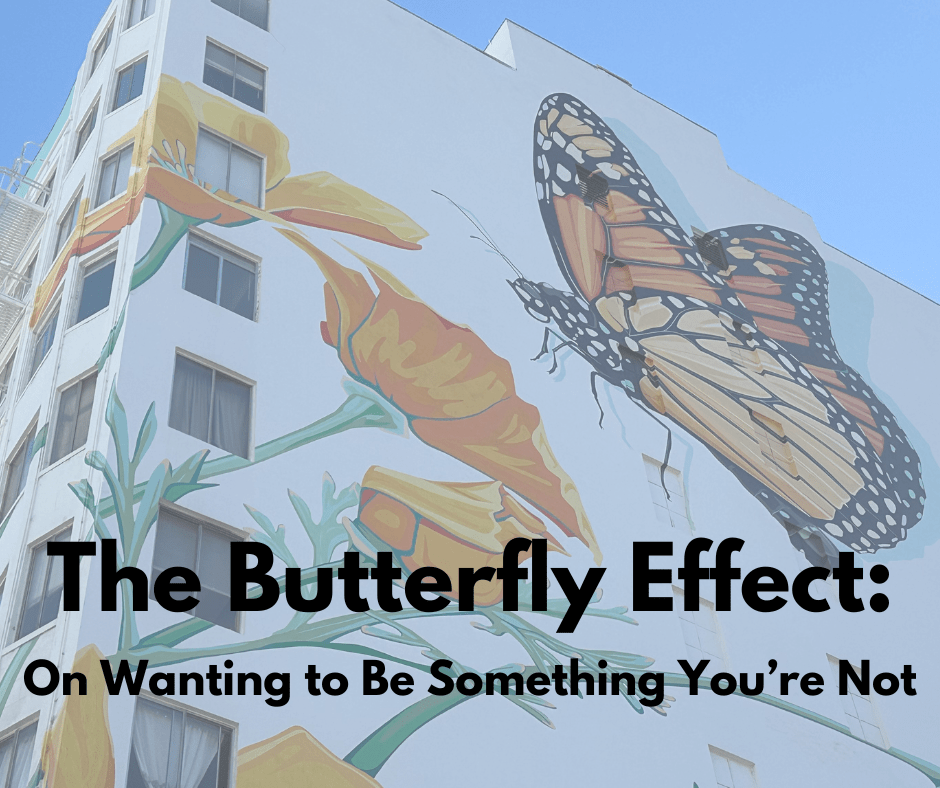
The Butterfly Effect: On Wanting to Be Something You’re Not

The Butterfly Effect: On Wanting to Be Something You’re Not

I’ll blame the terrible, horrible, no good, very bad summer I had for this delusion I had of wanting to become a butterfly.

Not an actual butterfly, of course. I know I’m not an insect. But I’d been in such a dark place – from a severe infection on my leg, to losing my sweet, sweet dog Oke, and sustaining injuries in a car wreck that totaled my car- that I saw a light at the end of the tunnel in the form of getting accepted into an exclusive training program.

I had it all planned out. I would travel across the country, I’d knock the socks off the other students and instructors with my experience, my passion, and my knack for teaching. When I came back, I’d re-emerge from the dark cocoon of grief, illness, and injury, brighter, shinier, and ready to make an enormous impact by sharing my new skill set.

But that’s not what happened. Not at all.

Instead of the transformation I’d hoped for, I came back sleep-deprived and disillusioned, a rough version of myself. I even lost four pages of raw reflections I’d written, which I thought might be for the best. 

As I traveled home, inspired by one of my favorite podcasts – “The Emerald Podcast” – I wrote out a long plan for a detox, and a reset. The primary focus of this period of cleansing and renewal would be getting enough sleep, a subject matter that I teach, but know from a lifetime of experience that it’s easier said than done.

Slowly but surely, I started to feel like my normal self again, and for the second time that summer, I pulled myself up out of a deep, dark hole.

The evening I returned home from San Francisco, I met up with one of my best friends for dinner, and over our conversation, it dawned on me: I didn’t need to become someone different. I just needed to come back to myself.  I’m not a butterfly. I’m Katie Carlson. Purposeful, passionate, playful, resilient, unapologetic Katie.

It’s hard to blame myself for wanting life to be different, but I was failing to utilize one of the most powerful tools in my toolbox, me. My truest, most authentic self.

Like many people, particularly women, I struggle with “imposter syndrome”. As a civilian working in the field of law enforcement wellness, I feel pulled between knowing that I’m exactly where I’m supposed to be, doing exactly what I’m supposed to be doing, and a sense of defensiveness, feeling I need to prove that I belong in my field.

This sense of wanting to fit in draws me toward certain modalities of healing and wellness because they are more highly “accepted” in the field of public safety. My belief in the power of these more accepted modalities is deeply real. I’ve witnessed them in action. I’ve watched them work, over and over again. But that doesn’t mean I need them to justify my existence.

One positive thing, however, stuck out from the training. Even in a room of incredibly impressive people, folks with unmistakable credentials in the field, when the topic of conversation turned to holistic wellness practices, like yoga, wellness, and breathwork – and it did on multiple occasions – suddenly my credentials were unmistakable. 

Compared to about 64 hours of training in the widely-accepted healing modality, and another 24-30 as a practitioner, my yoga teacher training was 200 hours, and my meditation teacher training was 300 hours. I’ve taught almost 450 hours of yoga, and about 100 hours of teaching meditation. I’ve spent more than 400 hours, just since 2021, in my own meditation practice, and over 18 years, it’d be impossible to guess how many hours I’ve spent in yoga practice, but at least 1,000.

I don’t need to justify my existence, nor do I need to doubt the impact of my work in the field of public safety. The proof is in the pudding.

This whole thing has given me a much higher degree of compassion for people I see trying to figure out who they are, folks who are trying to figure out the truest version of themselves. So long as they aren’t causing harm, I’ll now try to suspend my judgment of them as inauthentic.

I went through a course recently with one of my favorite teachers, Nikki Myers, called “Healing Secrets, Healing Self”, and she would often reference Michaelangelo’s meticulous work on the statue of David in which discussed the pre-existing completeness of the status, noting that he just needed to chip away at everything that wasn’t David.

Our paths to authenticity, more often than not, are a matter of subtraction, not addition.

Over the course of our lives, we pick up a lot of stories. Families tell us what we should value. Political parties tell us how we should vote. Religious doctrines tell us what we should believe. Industries tell us how we should look. Corporations tell us what our goals should be. Social media accounts tell us how we should be doing in comparison with others.

All of this conditioning, all of these added layers, sediment, if you will, cloud our vision of the truest version of ourselves. The self that has always been there, that will always be there. 

I saw an Instagram post recently that said “Two people to impress: Your 5-year-old self and your 85-year-old self.”

So there’s good news, and there’s bad news. The good news is that we can in fact metamorphosize, though the timeline is different from that of a butterfly. We can transform our bodies, our minds, and our souls. The bad news is that you aren’t going to come out on the other side a different person. Yep, sorry, you’re stuck with you.

All of the physical conditioning and plastic surgery in the world can’t change the purity of your child-like soul and it can’t erase the scars that have been acquired along the way. But you can shed all of the things that you are not.

Unlike the metamorphosis of a butterfly, which is brief and linear, human transformation is cyclical and deeply rooted in our previous life experiences. Our transformation is ongoing, and even our truest, and most authentic versions of ourselves can shift and take new forms over time. 

When you are in your purpose, living your truth, being your most authentic self, it won’t matter what anyone else thinks. You might fall. You probably will, but you’ll fall forward. You might get criticized, but it can’t hurt you.

It might take some shedding, some cleansing, some experimentation to find the real you. But you’ll know it when you find it.

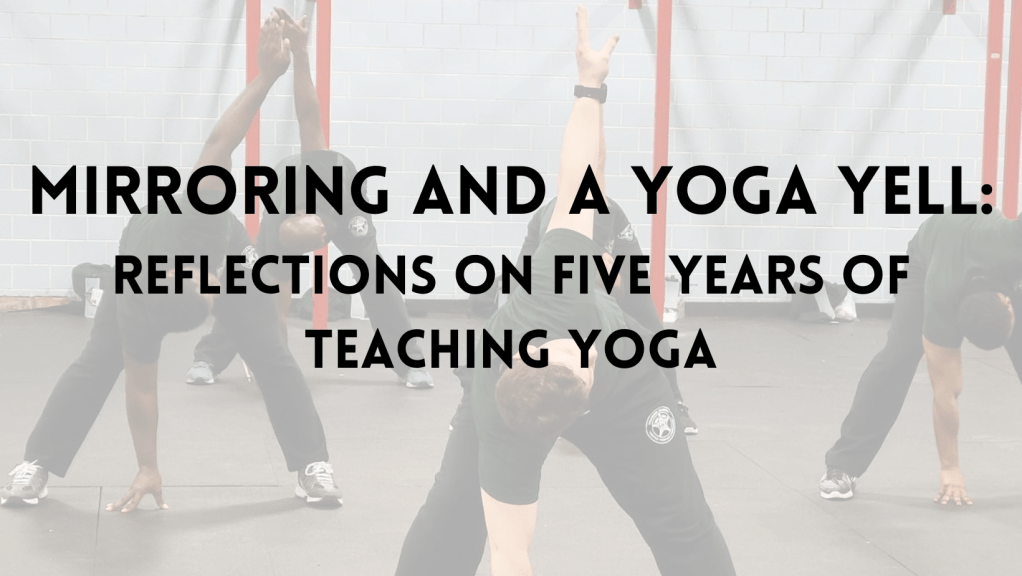
Mirroring and a Yoga Yell: Reflections on Five Years of Teaching Yoga

Monday, March 4th, 2024 was the five year anniversary of my Community Yoga class in Garfield Park, which means it was also my fifth anniversary of being an actual yoga teacher. I completely missed the anniversary, despite Community Yoga falling on a Monday and on the exact day. 

Our class – and I say “our” because it’s truly a class that belongs to our community – has bounced around to several locations. It began in the Burrello Family Center. About a year in, we were shut down due to COVID, we started back up outside that Fall, we took another pause, started back up outdoors that next Spring, moved inside to the Garfield Park Arts Center, first upstairs, and then downstairs, moved back outside, and now we’re at the Burrello Center again.

You know the saying “the more things change, the more they stay the same”? It was surreal coming back to the Burrello Center. I could feel the flood of terror I felt as a first time yoga teacher wondering what the hell I had gotten myself into, and arriving nearly 45 minutes early every week to walk around the room in circles repeating mantras to myself.

I almost didn’t go through yoga teacher training for one main reason. I’m not great at distinguishing my right from my left, or, it takes considerable thought, and sometimes looking for the “L” shape in my left hand. As a navigator, I drove many drivers crazy by simply pointing and saying “this way” or “that way” or “left, no I mean right!”

It didn’t stop me, though, because I didn’t think that I’d actually want to teach yoga. In fact, I’d convinced myself of that. “It’s just a way for me to get some additional education in the spiritual realm,” I’d say. “I’m mostly just interested in learning more about the philosophy of yoga. I love philosophy!,” I’d reason.

Well, the joke’s on me. 

I didn’t love teaching at first. It terrified me. I had imposter syndrome. I questioned my own authenticity. I picked apart my classes. I picked apart my appearance in the front of the classroom. Ironically, I didn’t start to love teaching until after the pandemic hit.

In the earliest days of the lockdown, I began “Yoga Lunch Breaks” on Facebook Live. A classic millennial, I felt a little more comfortable with a screen between me and my audience. But it became a lot more than that. When people were scared of them and their children and their parents of getting sick and dying, unable to leave their homes or obtain household basics, like cleaning supplies, I learned what it really meant to “hold space”. While acknowledging the fear and uncertainty in the world around us, I had the opportunity to create an accessible practice for people to connect to their body and their breath. It meant a lot to a lot of people, and it still gets brought up from time to time.

Teaching full length classes online, along with the Daily Lunch Breaks, helped me grow more confident as a teacher, and by the time Community Yoga was able to start back up outside, I was hitting my stride.

I had intentionally chosen to wait until I felt comfortable teaching yoga before requesting to teach it at the Marion County Sheriff’s Office Training Academy. I did not want to “practice” on incoming law enforcement personnel. I wanted to know that I could deliver them high quality classes. But by December of 2020, I was ready. One of my dear colleagues, now-Lieutenant Jason Kirlin, who oversees all physical training at the MCSO Academy, attended that first class for Detention Deputies, and immediately included yoga in the physical training of the next Deputy class. Without his belief in the benefits of the practice for law enforcement, I can hardly imagine that I would be in the position that I am today.

By June of 2021, I was teaching at the Indiana Law Enforcement Training Academy, as well as the Indiana State Police Training Academy, thanks to my friend, and an incredible trainer and leader in public safety wellness, Troy Torrence.

The rest, as they say, is history. Once I started teaching incoming law enforcement personnel, I never stopped. I also don’t shut up about it.

Another opportunity landed in my lap during the Summer of 2021. I had the opportunity to go through Mindfulness and Meditation Teacher Training through the Engaged Mindfulness Institute, a training organization under the same umbrella of the Center for Mindfulness in Public Safety, through which I met Troy, and several others who are now good friends.

Like the concern about knowing my left from my right, I had concerns about becoming a meditation teacher, too. Primarily, that I didn’t meditate that much. The opening “silent retreat” via Zoom almost killed me. I’d gone from meditating sometimes for about twenty minutes to being expected to meditate for hours a day. If I hadn’t been home by myself, I might have killed someone. I thought I had made a big mistake.

But as the training went on, I was soothed by a heavy emphasis on philosophy (“I love philosophy!”). Then, as we got into the techniques of teaching, not just teaching, or guiding meditations, but facilitating, something clicked in me. For years before I had been a volunteer at Girls Incorporated of Greater Indianapolis. I taught hundreds and hundreds of girls, usually between the ages of 9 and 11, in a variety of life skills, like conflict management and media savvy. I loved teaching the girls, but eventually parted ways with the organization. For a while, I felt that I didn’t have much to show for that investment in time (hundreds of hours over eight years). But as I began to facilitate meditation courses, I realized that not only did I have hundreds of hours in facilitation practice, but that training willing or required (in the case of recruits) adults is WAY easier than 9 to 11 year old girls. That transference of skill was such a blessing.

I’ll admit it. While I LOVE teaching yoga, I love teaching mindfulness and meditation even more. I think it’s a matter of accessibility…something that has always been very important to me. So while it would be unreasonable to expect everyone to love yoga (although I try to teach it in a way that makes it feel as good as possible), everyone, and I mean everyone, can benefit from mindfulness and meditation.

It makes me giggle because I remember in yoga teacher training when my teacher, the beloved Marsha Pappas, warned us against using a “yoga voice” or using an unnaturally soft, wispy voice to teach yoga. She said to just be ourselves. It’s easier said than done. When you have a room full of people who come with an expectation of leaving more relaxed than when they arrive, you want to sound soothing. However, when I teach yoga and meditation at the Indiana Law Enforcement Training Academy, it is me, in a gym, and about 150-160 cadets. I don’t have a “yoga voice”, I have a “yoga yell”. That same “yoga yell” carries outdoors for our Community Yoga class. And yet, somehow, people, whether they are in the Park, or at the Training Academy, still tend to leave a little more relaxed than when they came. So there must be something to that sense of authenticity.

And how are things going with my left and right, you ask? Well, in the past year or so, I have taught myself how to mirror, so that when I’m facing a class, and calling out for them to step their right foot forward, I’m stepping my left foot forward, mirroring them. I’m still surprised I can do this, but I can observe the considerable impact this skill has on my effectiveness as a yoga teacher and demonstrating the poses, especially to those totally new to yoga. But sometimes I still have to shout out, “left, no! I mean right!” and vice versa.

All this is to say, I can’t believe I’ve been teaching for five years. I can’t believe it’s ONLY been five years. It feels like a lifetime. I’m grateful to so many people… my many teachers, my friends and colleagues at the Training Academies, and every student (probably close to 2,000) who has ever trusted me with a configuration of their body or their breath. And I’m so excited to see where it goes from here.

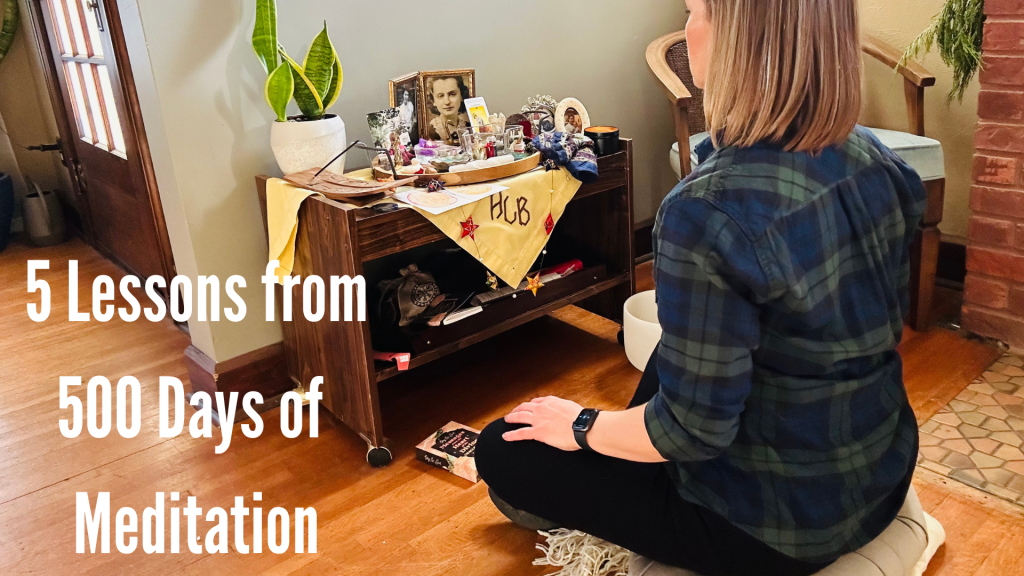
5 Lessons from 500 Days of Meditation

I’ve been waiting to write about meditation. First, I passed the point of 100 consecutive days, and though the benefits of the daily practice were practically bursting out of me, I thought that 100 days wasn’t impressive enough. I’ll share at the one year mark, I thought.

The one year mark came and went amidst a lot of chaos, chaos that was softened by leaning heavily on my meditation practice. But with no time to write about it.

But on December 12, 2023, I hit 500 days of consecutive meditation practice! 

Mindfulness meditation practice has made a huge impact on my life, but I’m going to boil what I’ve learned over 500 consecutive days of meditation down to 5 lessons.

  1. Be Your Own Biggest Cheerleader. If there is one biggest impact that mindfulness meditation practice has had on my life, it’s this. I spent decades of my life beating myself up. Whether it be harshly judging my actions and/or my appearance, or comparing myself to others, I was not nice to me. But in meditation practice, there’s an opportunity to change that running narrative. Sometimes people think that meditation is about being able to concentrate for a certain amount of time without being distracted, so they think they “aren’t good at it”. But meditation is about recognizing when your mind wanders, and gently, with kindness toward yourself, bringing your attention back. That sense of kindness toward myself… replacing the “Katie, you suck at this” with “That’s okay! Just bring your attention back!” seeped into the rest of my self-talk. Over time, I’ve gone from my own worst critic, to my own biggest cheerleader, and the cheer is: “It’s okay! Keep going!”
  1. Show Up for Yourself. Sometimes self-care is described as “putting on your own oxygen mask first”, which is apt, especially if you frequently put the needs of others above your own, or are pouring from an empty cup. But the truth is that service to others isn’t the only reason that we don’t give ourselves the self-care we need. Stress and overwhelm can make us forget about our true capacity to show up for ourselves. We may also forget that showing up for ourselves doesn’t have to mean finding an hour to take a yoga class, or a twenty minute meditation. My teacher, Fleet Maull, taught that in mindfulness, we must “take our seat”. That may mean taking our seat on an actual meditation cushion, but it also just means showing up, and arriving at your practice. The secret is that even if you just show up for yourself for one minute, or five minutes, “It’s okay!” (see above). 
  1. Just Breathe. Our breath is so important. When we can control nothing else around us, we can control our breath. And while we’re lucky that we don’t have to think about each breath we take, our bodies SAVOR the intentional assistance with our breath. There is a lot of anatomy and neuroscience behind breath work, and why it’s so effective, but I’m not going to rehash that here. But I joke as I’m teaching breath work, yoga, mindfulness, meditation, and other resilience practices to public safety personnel, “Have you noticed that we are mostly just breathing?!” As you read this sentence, take three big, deep breaths. Then notice how you feel. Your body and mind will thank you.
  1. Actively Direct Your Energy. This might tie with softening my self-talk for the biggest impact that mindfulness has had on my life. Or they just go hand-in-hand. It’s pretty simple, actually. We can passively let life happen to us, or we can make choice after choice after choice to spend our energy on the things that are important to us. But first, it helps to be crystal clear about what’s important to you. Make a list. Mine is something like: family, friends, my dog OkeDoke, my personal health and self-care, my work, my hobbies (like climbing and teaching), serving my community, my relationship with God, and all people, beings, and things. Then make another list. What gets in the way of those things that are important in your life? We practice mindfulness meditation not so we can qualify for the Best Meditator Ever Award, but so we can strengthen our muscle of mindfulness – that noticing of when our mind has wandered, and gently bringing it back – so that we can live our lives with our energy and attention directed at the things that really matter. Recognize what distracts you (phones, meaningless drama, bad habits, etc.), and direct your attention and energy back to the things on this first list. And guess what! If you get distracted, and have to start over, “It’s okay!”
  1. You Can Always Start Again. As the Japanese proverb, and many other iterations go, “Fall down seven times, and get up eight.” Whether you’re directing your attention during a five minute guided meditation practice, or implementing a new self-care routine, it doesn’t matter how many times you have to start over, as long as you start over. It’s totally okay.

Bonus: Some of my favorite authors, like Gretchen Rubin and James Clear, write about “habit stacking”, one of the most useful methods I’ve used to implement healthy habits. So while I hope to have convinced you to consider adding a mindfulness meditation practice to your life, think about what you are already doing. Do you pull into a certain parking spot each day? Stack a 1 minute mindfulness practice onto parking. But another option is this: Stack your mindfulness practice with a gratitude practice and/or prayer. They go hand in hand. And I won’t promise much, but I’ll promise this. You’ll never regret taking three big breaths and listing three things you are grateful for.

Start small, folks. My meditation practice took many years, many 21 Day Challenges, many courses, many articles, many apps, and a 300 Hour Meditation Teacher Training to develop – not to mention the past 500 (!) days – and I get distracted during meditation ALLLLLLL THE TIME. I’m always interested in deepening my practice, including extending the length of the practice. But the current length (about 20 minutes daily, followed by gratitude and intention setting) is one that fits well into my morning routine, and is something that I can maintain. It’s been encouraged that I participate in annual silent mindfulness meditation retreats and everything inside of me pouts, “But I don’t wanna”. My practice has lots of room to grow, but for now, it is where it is and that’s okay.

I’m endlessly grateful for the people and organizations who have helped me develop this practice. It started with the Center for Mindfulness in Public Safety, including my teachers and friends Dr. Fleet Maull, Vita Pires, John MacAdams, Julie Paquette, and Robert Ohlemiller. I completed my 300 Hour Mindfulness and Meditation Teacher Training through the Engaged Mindfulness Institute, with the same amazing people listed above.

The Reticent Traveler: On Naming Your Fears Then Facing Them

In the world of dating, it’s probably the most “uncool” thing about me. 

For the approximate ten days (over several years, and not currently) that I have been able to stomach Bumble, it’s clear that travel is hobby number one for eligible bachelors. A scroll through their profiles will tell you this much. “This could work if… You have more stamps in your passport than me” or “My ideal date is… A last minute trip to Croatia”.

Even on real life dates, my lackluster approach to travel has sealed the deal on my potential.

It’s not that I don’t enjoy doing new things, and visiting new places, and appreciating cultures other than my own… I do!

There’s no fear of flight involved. In fact, I love to fly. The daughter of a recreational pilot and aviation nut, I have such fond memories of sitting next to my Dad on planes, so excited for the take off and landing. In fact, if given the opportunity to ride as a passenger with the Blue Angels, I’d do it.

So what was stopping me? 

Money is a factor. As a public servant, I have a job I adore, and an income that I’m grateful for, but as a single woman paying all of her own bills, there’s not a ton left over. And I’ve always just assumed that travel wasn’t a big priority for my discretionary spending.

But the bigger factor has been my dogs, or now, just one dog, OkeDoke. She and her sister HATED being boarded, so travel required securing a dog sitter and incurring those expenses.

But it’s me with the separation anxiety. I hate being away from Oke. I hate missing our morning routine. I hate worrying about whether or not she’s going to get outside in a timely manner. I hate feeling like she’s wondering when I’m going to come home. She will turn 12 this year, and she’s slowing down. I lost her sister so suddenly that I’m terrified that Oke will get sick or hurt while I’m away.

For these reasons, primarily dogs, and secondarily money, I wasn’t very interested in travel and really hadn’t thought about it very much. Until the past year.

My Mom wanted to take me on a trip for my 40th birthday. She was down to go anywhere I wanted. My first thought was the Greek Isles. One of my best friends has gone multiple times, and it just looks like a dream… not to mention one of my favorite cuisines. So it sounded like a great idea.

But as the planning began, I could feel myself tensing up. There was so much distance between this person I wanted to be, who could dart off on an adventure, and the person who was actually there.

I noticed it the most when I started to feel angry and unseen by my friend for giving me the travel advice I had been asking her for, especially when she suggested that a week wasn’t enough time and that ten days would be better. I thought “does she not realize how hard this is for me!?”

That’s when I called my Mom and threw the brakes on the Greek Isles. I said “it’s too much and it’s too long”. My Mom, who has taken a number of international trips in recent years with her sisters, said: “Katie, you have travel anxiety. It’s common.”

At that moment, I felt a shift. I felt less alone. “It’s common.” 

I know a thing or two about anxiety. I have carried the diagnosis of General Anxiety Disorder for many years.

Researcher and author Brene Brown, particularly in her wonderful book (and HBO Max series) “Atlas of the Heart”, discusses how important it is to be able to identify our emotions, and how misidentifying our emotions can prevent us from seeking or accepting the support that we really need.

Once my “travel anxiety” was named, I could start to get the support I needed and begin to truly process it.

I called my friend back and said “turns out, I have travel anxiety” to which she replied with love and humor “yes, we all know”.

She had moved to Philadelphia almost 9 years earlier, and I’d never gone to visit. I’d made another friend feel rejected at times when I’d turned down her requests to go on a trip here or there. None of it had been purposeful or particularly conscious, especially not to me.

With awareness of my travel anxiety, I could begin to take baby steps. I have loads of energy and drive, and generally allow nothing to hold me back, but especially not myself.

Without plans for international travel, I applied for and received my U.S. Passport, so that’s out of the way.

Part of the reason I was hesitant to take the longer trip with my Mom is because the two of us were already planning to go to Florida for a week this Spring. That full week will easily be the longest time I’ve been out of the state in over a decade. I’d already been nervous about it, but it’s a vacation that my Mom had booked with my Dad before he died last year, so when she asked me to go with her, my answer was “of course”. It turns out that travel anxiety is no match to a daughter who wants to be there for her Mom.

But as far as my 40th birthday trip goes, already having planned to be away for a week in Florida, I wanted something lower key. So we made plans for a long weekend in Savannah instead and I’m looking forward to it.

I’ve been coming to realize, as I advance and excel in my career, that more travel to conferences would become necessary.

Last winter, as I was attempting to break through the writer’s block I’d encountered after the death of my father, I wrote two presentation proposals for a conference. A couple weeks ago, I learned that BOTH had been accepted, and I began the process of planning yet another trip, this time for work, for four nights in Baltimore. It’s a little ironic, isn’t it, that I’m more nervous about leaving my dog than giving two separate presentations in rooms full of strangers!? Apparently my travel anxiety is also no match to the passion I have for my work. 

But how could I go out to Baltimore and not visit my best friend an hour or two away in Philadelphia?! So I’m tacking two more nights on the trip, and after the conference, I’m taking the train from Baltimore to Philly.

The twenty nights I’m going to be on the road in the first five months of 2023 will add up to be more nights than I’ve been away from home (without my dog) in the last five years combined. And if I’m honest, I’m really nervous about all of it, mostly about leaving Oke. But I’m proud of myself, too, for working through my own fear and discomfort.

While my travel anxiety mostly seems to surround my dog and finances, there’s one other element that’s been holding me back. Comfort and contentment. I’ll probably always be a bit of a homebody because I love my house. I love it every single time I come home and am met by Oke. I love my neighborhood and I love my city. There’s an adage that you should “create a life that you don’t need a vacation from”. And while I agree with that in terms of escaping our problems rather than confronting them, I now see how it can go too far the other way. The true essence of “home” is a place that you can always come back to, whether that’s a physical house, a certain town or city, an idea or feeling, even a person, or a pet. But to come back, you have to leave, and if you can’t leave, are you at home or are you stuck?