Sweet Clarity: Choosing to Feel, Heal, and Shine

Today marks 100 days with no alcohol! It’s probably the 3rd or 4th time I’ve hit this milestone. I don’t consider myself “sober”. I don’t like that word very much. And at this moment, I don’t foresee alcohol in my future. But you have to know yourself, and I know telling myself “never” or “forever” doesn’t work for me.

I’ve never considered myself an alcoholic. I never hit a rock bottom. My choices while using alcohol never negatively affected or impacted other people. If anything, I become more bubbly and pleasant with a couple drinks in me.

But there came a point, about six or seven years ago, when I realized that I couldn’t remember the last time I had gone a day without two or three glasses of wine. That pattern settled in without me realizing it. Numbing had long been one of my ‘go-to’ responses to a series of traumatic events in my teens and early twenties. As a young adult working in the toxic and hard-partying environment of the Indiana Statehouse, alcohol-fueled evenings became the norm. In 2012, I went through a challenging divorce while managing a Congressional campaign in Southern Indiana, and the two to three glasses of wine a day became a balm.

Then I began my career in public safety. I fell in love with the field, but I went from living in the green to living in the orange, a heightened state of stress and vigilance. Suddenly, I was ultra aware of every bad thing happening in my community, and as the sole Public Information Officer, I was on call to the media 24/7/365.

The first time I took a break from alcohol was like a punch in the face. Without my rosé-colored glasses, I looked at my life and I did not like what I saw. I didn’t like how I was spending my time, I didn’t like how I looked, I didn’t like how people were treating me. I was neglecting my health, my passions, and my boundaries.

I was going through a program called “Hip Sobriety” that I’d stumbled across on Instagram. The founder, Holly Whitaker, eventually wrote a book “Quit Like a Woman”. I’d highly recommend it.

And while I didn’t stay “dry” beyond that 8 week program (it had never been my intention)… my eyes were open, and I couldn’t unsee what I saw.

Three things all happened around the same time. I stopped drinking for the first time and began a long conversation with myself about my relationship to alcohol. I found my current therapist! I don’t know what I would do without her. And I signed up for Yoga Teacher Training. It was something that I had always wanted to do, but it was never the right time. After the “sobering” view of my life, I decided that I was doing it, and nothing was going to stop me. The rest is history.

Obviously, teaching yoga has been deeply transformative for me. I wasn’t sure if I wanted to actually teach at first. My early motivations were more along the lines of education. I knew I wanted to write and talk more about spirituality. Being a yoga teacher could be a platform for that. What I wasn’t expecting was for the philosophy and energy systems behind yoga – aspects of the practice that are often overlooked in Western yoga practices – would begin my journey to healing deep-seated trauma. I also didn’t realize that this healed—or continually healing—version of myself, who once dreamed of sharing these transformative practices with my colleagues in public safety, would soon have the opportunity to create meaningful change in my community and present these practices (and more!) on stage at international conferences.

When I talk about my work, I often tell people that I have to pinch myself that this is really my life. And that’s mostly because this was NOT THE CASE just a handful of years ago.

Over the past several years, there have been times when I have slipped back into old habits, particularly when I’ve been in mourning or when life has just been kicking my ass.

But when I rededicate myself, not to sobriety, but to CLARITY, to feeling all the feels without turning away or numbing, it reminds me of my wholeness, my inner worth, and what I (and all of you) deserve: to wake up in the morning ready to make a difference, and to whole-heartedly reject the ideas, the people, and yes, the substances that dim my inner light.
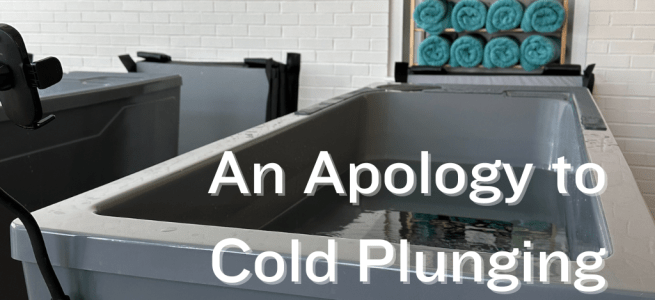
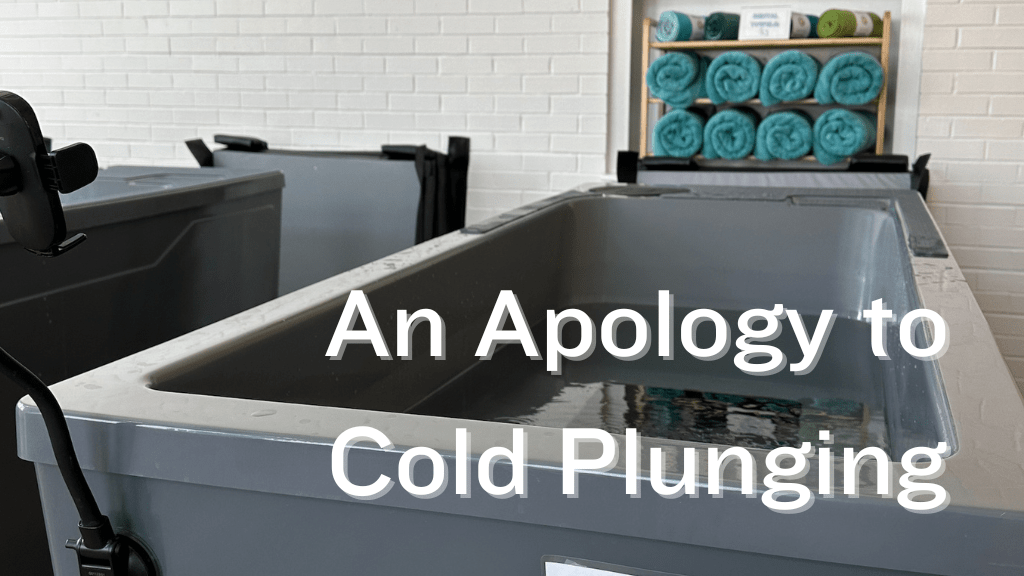
An Apology to Cold Plunging

I can admit it when I’m wrong. And I was wrong about “cold plunging”.

My misperceptions (or most of them) at least came from my heart being in the right place.

This past week, I’ve been in several discussions about the impact that critical events might have on our worldviews, either affirming or denying them. A slightly more casual worldview could also be defined as a personal value.

I’ve mentioned her in other writing, and I’ll mention her again. In her book “Real Self Care”, Dr. Pooja Lakshmin argues the differences between faux self-care and real self-care. Faux self-care includes retreats and cleanses that are out of reach for all but a few. Faux self-care is a narrative that is dominated by a capitalist society constantly reminding us that by buying this or that we can come a little bit closer to being perfect.

Real self-care, on the other hand, is something that no one can give you but yourself, like moving your body in ways that feel good, nervous system regulation and setting boundaries.

A value that’s central to my yoga and meditation practices is accessibility. With some judgment, perhaps, I question anything that can get in the way of a person and these powerful practices. 

Short on time? You can see the benefits in 5 minutes!
Flexibility or body image holding you back? Come to my class! It’s a safe and diverse space. I offer many variations of each pose. Move in a way that feels good to you.
Tight budget? My class is free! Everyone should have access to yoga! You don’t need fancy clothes, or mats. You can even develop a yoga practice from YouTube!

Where barriers between people and these practices exist, I want to be there, knocking them down.

I’ve long heard of the benefits of cold plunging, if not through online courses offered by Wim Hoff, through colleagues of mine in public safety wellness, colleagues I trust and whose opinions I hold in high regard.

But a practice that you need a special tub, and/or bags of ice? Feels inaccessible to me.

Less generous than my worldview that everyone should have access to wellness practices, regardless of their resources, was also a judgment that cold plunging was… I think I’ve called it… “bro wellness”. I apologize for that, y’all. Truly.

Between the special equipment, and the videos with the grunting, I misjudged it as hyper masculinity. But I was wrong.

I’ve been particularly rigorous with my body lately. On purpose! I’ve adopted this credo by Seneca: “The body should be treated rigorously, so that it may not be disobedient to the mind.”

But as I hone in my passion for climbing, and continue on a streak of building strength, steadily climbing (about three times a week), with no injury, I’m testing the limits of my body. I walked into hot yoga knowing my arms were very sore and tired.

Hot yoga is another one of those value-questioning practices. Do you really need to pay for a pricey class, to be in a room over 100 degrees and sweat through every article of clothing you’re wearing to have a yoga practice? No. But dang it if hot yoga doesn’t help my body repair itself, especially for mild injuries and pain. And I just love the teacher, Patrick. He teaches yoga in a way that’s accessible to any level of yoga experience, from a beginner to a long time practitioner, like me. So it checks off my “accessible” value box.

The studio had just opened a “cold therapy” room across from the hot yoga room. Two weeks ago, I kind of rolled my eyes. This time, I eyed it and poked my head in thinking… “that might feel good”. Before yoga began, Patrick shared that he was going to plunge after class and that we could do it together. And that was that. I signed up for a plunge following class.

There was one more obstacle, which was that including rinsing off in the shower after the hot class, you needed to be wearing clean plunging clothes or a swimsuit. It’s a rule with which I whole-heartedly agree, but wasn’t prepared for. $20 later, with a swim suit off of the clearance rack, I was ready. 

I chose the coldest of the three plunges because “why not”. The temperature was set at 40 degrees. Patrick set a timer for three minutes on his phone, and we got in.

I knew what I had to do, which was focus on my breath. And from the moment I entered the water until those three minutes later, I practiced straw breathing. 

I teach straw breathing all the time. To hundreds of incoming law enforcement personnel every year. To the public. To inmates. To colleagues recovering from critical incidents. To other peer support team leaders across the country. I jokingly called it my “Katie, get your shit together breath”. Straw breathing is what I know I can turn to for self-regulation.

And in the plunge, straw breathing worked. Perfectly. Under the somewhat bizarre and unnatural conditions of sitting in a very cold bath, I kept my cool. While I could deeply sense the bitter cold on my skin, the contraction in my muscles, and felt so much activity in my body’s reaction to the cold water, I kept my heart rate under control. I kept myself out of fight, flight, and freeze. 

After the three minutes was over, when feeling slowly crept its way into my body, a sense of joy sunk in. Some call it euphoria. I just felt very, very alive. And happy. Happy because this technique I teach so often to so many people works. I already knew that it worked. I use it all the time. People frequently tell me about how it has helped them. And while I encourage practicing straw breathing, or any type of breath work practice, regularly, so that it kicks in naturally, I can’t imagine a better way to send your nervous system into high gear, and practice bringing it back into regulation better than cold plunging.

So this is my formal apology to cold plunging: I misjudged you. You are not “bro wellness”. You are a very, very practical tool for training our ability to self-regulate our nervous systems. I just wish everyone I teach nervous system regulation skills could have access to this method of practice. 

This is where we run back into that matter of accessibility. Maybe I’ve had my sight set on the wrong targets. I’d been judgmental about the existence of options, like cold therapy and fancy wellness spaces, when the real problem is the aforementioned capitalism. The problem is a system that sucks billions of dollars to the top few, and leaves our communities struggling to fund public services, community investment, and comfortable wages for the men and women who take on the most challenging work. So while it’s both my job and my passion to figure out how to provide access to wellness services, it’s our job as a community to remember that next time we’re fighting each other, up regulating our nervous systems because it’s us versus them, that the billionaires and corporations are glad we’re distracted, unhealthy, unfulfilled and ignoring them as they laugh, “no wellness for you!”

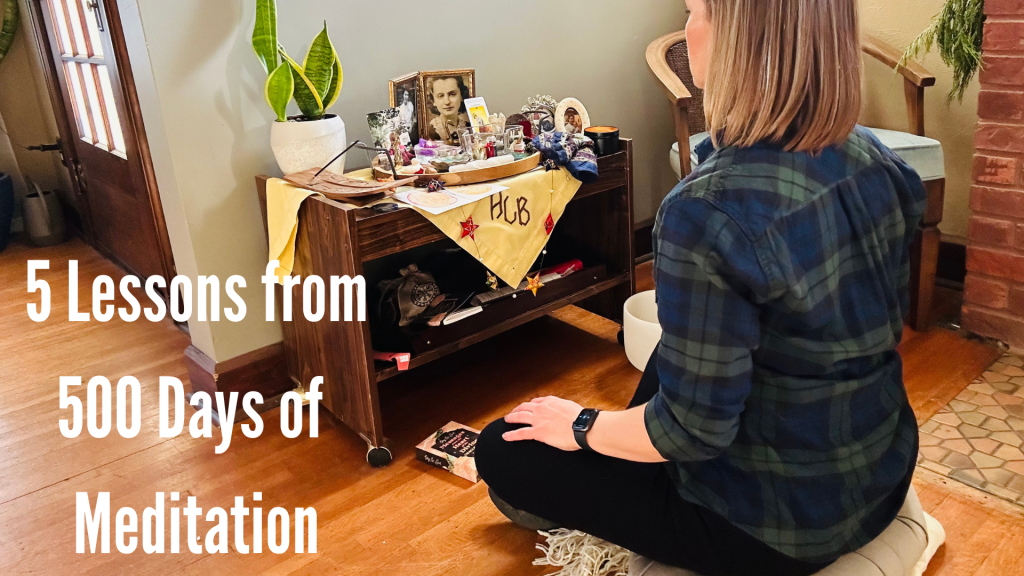
5 Lessons from 500 Days of Meditation

I’ve been waiting to write about meditation. First, I passed the point of 100 consecutive days, and though the benefits of the daily practice were practically bursting out of me, I thought that 100 days wasn’t impressive enough. I’ll share at the one year mark, I thought.

The one year mark came and went amidst a lot of chaos, chaos that was softened by leaning heavily on my meditation practice. But with no time to write about it.

But on December 12, 2023, I hit 500 days of consecutive meditation practice! 

Mindfulness meditation practice has made a huge impact on my life, but I’m going to boil what I’ve learned over 500 consecutive days of meditation down to 5 lessons.

  1. Be Your Own Biggest Cheerleader. If there is one biggest impact that mindfulness meditation practice has had on my life, it’s this. I spent decades of my life beating myself up. Whether it be harshly judging my actions and/or my appearance, or comparing myself to others, I was not nice to me. But in meditation practice, there’s an opportunity to change that running narrative. Sometimes people think that meditation is about being able to concentrate for a certain amount of time without being distracted, so they think they “aren’t good at it”. But meditation is about recognizing when your mind wanders, and gently, with kindness toward yourself, bringing your attention back. That sense of kindness toward myself… replacing the “Katie, you suck at this” with “That’s okay! Just bring your attention back!” seeped into the rest of my self-talk. Over time, I’ve gone from my own worst critic, to my own biggest cheerleader, and the cheer is: “It’s okay! Keep going!”
  1. Show Up for Yourself. Sometimes self-care is described as “putting on your own oxygen mask first”, which is apt, especially if you frequently put the needs of others above your own, or are pouring from an empty cup. But the truth is that service to others isn’t the only reason that we don’t give ourselves the self-care we need. Stress and overwhelm can make us forget about our true capacity to show up for ourselves. We may also forget that showing up for ourselves doesn’t have to mean finding an hour to take a yoga class, or a twenty minute meditation. My teacher, Fleet Maull, taught that in mindfulness, we must “take our seat”. That may mean taking our seat on an actual meditation cushion, but it also just means showing up, and arriving at your practice. The secret is that even if you just show up for yourself for one minute, or five minutes, “It’s okay!” (see above). 
  1. Just Breathe. Our breath is so important. When we can control nothing else around us, we can control our breath. And while we’re lucky that we don’t have to think about each breath we take, our bodies SAVOR the intentional assistance with our breath. There is a lot of anatomy and neuroscience behind breath work, and why it’s so effective, but I’m not going to rehash that here. But I joke as I’m teaching breath work, yoga, mindfulness, meditation, and other resilience practices to public safety personnel, “Have you noticed that we are mostly just breathing?!” As you read this sentence, take three big, deep breaths. Then notice how you feel. Your body and mind will thank you.
  1. Actively Direct Your Energy. This might tie with softening my self-talk for the biggest impact that mindfulness has had on my life. Or they just go hand-in-hand. It’s pretty simple, actually. We can passively let life happen to us, or we can make choice after choice after choice to spend our energy on the things that are important to us. But first, it helps to be crystal clear about what’s important to you. Make a list. Mine is something like: family, friends, my dog OkeDoke, my personal health and self-care, my work, my hobbies (like climbing and teaching), serving my community, my relationship with God, and all people, beings, and things. Then make another list. What gets in the way of those things that are important in your life? We practice mindfulness meditation not so we can qualify for the Best Meditator Ever Award, but so we can strengthen our muscle of mindfulness – that noticing of when our mind has wandered, and gently bringing it back – so that we can live our lives with our energy and attention directed at the things that really matter. Recognize what distracts you (phones, meaningless drama, bad habits, etc.), and direct your attention and energy back to the things on this first list. And guess what! If you get distracted, and have to start over, “It’s okay!”
  1. You Can Always Start Again. As the Japanese proverb, and many other iterations go, “Fall down seven times, and get up eight.” Whether you’re directing your attention during a five minute guided meditation practice, or implementing a new self-care routine, it doesn’t matter how many times you have to start over, as long as you start over. It’s totally okay.

Bonus: Some of my favorite authors, like Gretchen Rubin and James Clear, write about “habit stacking”, one of the most useful methods I’ve used to implement healthy habits. So while I hope to have convinced you to consider adding a mindfulness meditation practice to your life, think about what you are already doing. Do you pull into a certain parking spot each day? Stack a 1 minute mindfulness practice onto parking. But another option is this: Stack your mindfulness practice with a gratitude practice and/or prayer. They go hand in hand. And I won’t promise much, but I’ll promise this. You’ll never regret taking three big breaths and listing three things you are grateful for.

Start small, folks. My meditation practice took many years, many 21 Day Challenges, many courses, many articles, many apps, and a 300 Hour Meditation Teacher Training to develop – not to mention the past 500 (!) days – and I get distracted during meditation ALLLLLLL THE TIME. I’m always interested in deepening my practice, including extending the length of the practice. But the current length (about 20 minutes daily, followed by gratitude and intention setting) is one that fits well into my morning routine, and is something that I can maintain. It’s been encouraged that I participate in annual silent mindfulness meditation retreats and everything inside of me pouts, “But I don’t wanna”. My practice has lots of room to grow, but for now, it is where it is and that’s okay.

I’m endlessly grateful for the people and organizations who have helped me develop this practice. It started with the Center for Mindfulness in Public Safety, including my teachers and friends Dr. Fleet Maull, Vita Pires, John MacAdams, Julie Paquette, and Robert Ohlemiller. I completed my 300 Hour Mindfulness and Meditation Teacher Training through the Engaged Mindfulness Institute, with the same amazing people listed above.

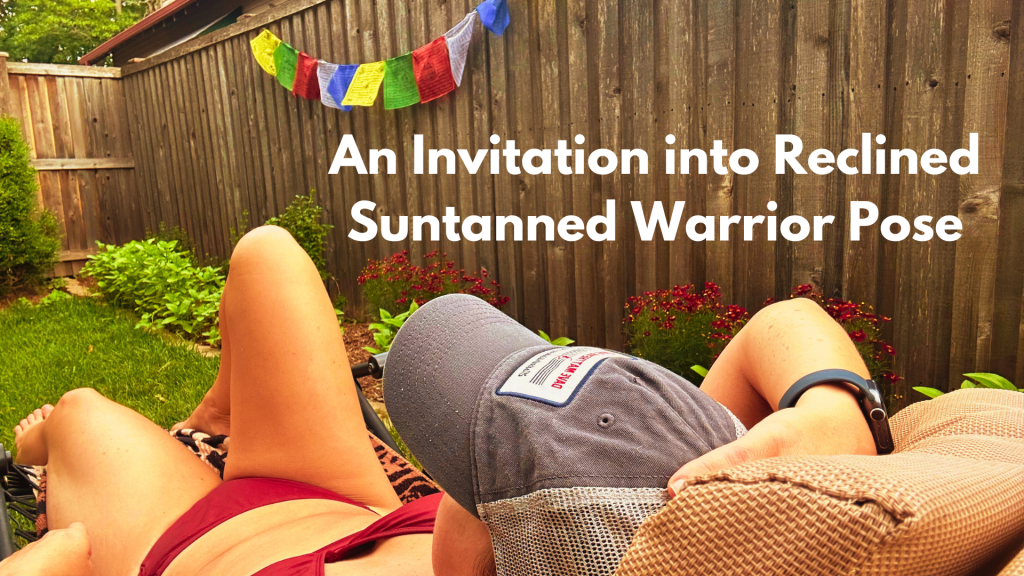
An Invitation into Reclined Suntanned Warrior Pose

I set an intention for a simple summer. More specifically, I set an intention to get a good suntan. Something so simple, and seemingly free, seems like it would be easy to accomplish. And yet, the past several summers, I have lamented the lack of contrast between my tanned and swimsuit-covered skin… the kind of contrast my friends and I would joyfully compare as girls during our long summer days at the pool.

All of a sudden, it seems, the sun became “bad for our skin”. Around the same time I started thinking about wrinkle prevention, a friend my age (exactly my age – we were born the same day) died of skin cancer. 

Since then, I’ve been wearing hats in full sun, making sure my beauty routine included SPF, and the SPF 4 bottles of Australian Gold were replaced with SPF 50+ Sport.

The only time I really wore the SPF 50 on my body, however, was for a day by the ocean, lake or pool. And considering I don’t have regular access to any of those things, those days were few and far between.

I’d exercise outdoors early in the morning, and limit the amount of time spent in the sun during peak hours. I’d spend time outside in the shade with friends and boyfriends, but I daydreamed of opportunities to lay in the sun, somehow thinking I needed to go somewhere to do that. As if the sun in which I now soak lazily in my backyard is bad, but the sun by a pool is good.

Before accompanying my Mom on a 7 night trip to Florida, just before turning 40, I made my first appointment with a dermatologist. I felt guilty for waiting too long to see one. But she looked over my entire body, kindly called the sun spots all over my arms “wisdom spots”, and didn’t see anything cancerous or precancerous. The part of me that had always feared the sun shining on my face through the car window felt considerable relief.

The trip to Florida with my Mom was the longest vacation I’d taken in… ever? Slowing down was hard. But there were a few hours a day, from about 10:00 am to 1:00 pm, where I would lay out by the pool, and that time would fly. Sometimes I would contemplate the busy season of life in front of me, but the rest of the time, I’d listen to podcasts and read. With the confidence of my dermatologist’s report, regularly applying SPF 50+ and wearing a hat, I’d let myself bask in the warmth of the sun and glow in the shine of sunscreen. I’d take “thirst trap” photographs (and post them!) and I felt happy. By intentionally lying there in the sun, doing seemingly nothing, I was doing something… for myself. In addition to resting, I was rebuilding my connection with the sun, the giver of life on this little planet of ours, shifting our relationship from one of fear to one of nourishment.

Shortly upon my return from Florida, that busy season of life I’d been contemplating came and went. And at the end of it, feeling like I’d been slowly and painfully dragged into June, I pulled my outdoor lounge chair from the deck to the sunniest part of my backyard, and promised myself that this summer, I was going to get a suntan. 

It’s funny to me that historically nobility would pride themselves on their pale skin, a sign that they did not have to work out in the fields. As I lay out in my backyard, watching the same breeze that’s brushing past my skin flow through the peace flags adorning my fence, I daydream that if I were nobility, I’d do this very thing, but perhaps next to a pool, completely surrounded with tall pines for enough privacy to avoid having any tan lines at all.

That’s how I feel when I lay out in the sun, though, as if I’m nurturing my own inner nobility. A nobility that reminds me that I don’t have to be busy all the time, and I don’t always have to be doing something. Basking in the connection I feel to the sun, to the Earth, to the weather, to my home, and to myself… It feels luxurious. And while it is reasonably accessible, it’s still not a luxury afforded to all.

The activist Audre Lorde said: “Caring for myself is not self-indulgence, it is self preservation, and that is an act of political warfare.”

And in her book “Real Self Care”, Dr. Pooja Lakshmin argues the differences between faux self-care and real self-care. Faux self-care includes retreats and cleanses that are out of reach for all but a few. Faux self-care is a narrative that is dominated by a capitalist society constantly reminding us how flawed we are, and that by buying this or that, we can come a little bit closer to being perfect.

Real self-care, on the other hand, is something that no one can give you but yourself, like time to yourself, and setting boundaries. And still, sadly, time to lounge, even at zero cost, remains inaccessible to people like sole caregivers and those struggling to resource themselves and their families with basic needs.

So while my goal of getting a nice suntan this summer may sound flippant, it is not. While women are losing bodily autonomy regarding choices for their own health care, safety, and economic circumstance, as dictated by the highest Courts, doing what I want with my body, even if it’s sprawling out on a lawn chair, is an act of political warfare. 

As I lay out under the warm blanket of the sun, I look at those “wisdom spots” on my arms and notice new patches of stretch marks on my thighs. I know that somewhere a group of people is inventing a new, shiny solution to this non-problem. And another group of people are preparing the marketing for this shiny solution. And the minute I pull the trigger on trying to fix this problem, another will pop up. And hard as they try, the people in these rooms will never get to the root cause of their problems with my body… that it is just getting older! Laying out in the sun, carefully enough to be cautious of skin cancer, but without any shits to give about my non-cancerous sunspots or the weird, pale line on my belly from where my skin folds together to form a miniature ravine of SPF 50+ Sport… is an act of political warfare.

And that tricky fawn response to trauma, to people pleasing, over-achieving, and social media inundation reminding us that even if we try to do everything, we will never be good enough… Though my sights are aimed high in a career I love, choosing to spend as much time as possible in the sun this summer, tapping myself out of a competition to produce and do as much as possible, listening to podcasts and music, and allowing my attention to rest on the activity of bees buzzing amongst my flowers, is an act of political warfare.

All that said,  if it’s a sunny afternoon this summer… you’ll know where to find me.

The Reticent Traveler: On Naming Your Fears Then Facing Them

In the world of dating, it’s probably the most “uncool” thing about me. 

For the approximate ten days (over several years, and not currently) that I have been able to stomach Bumble, it’s clear that travel is hobby number one for eligible bachelors. A scroll through their profiles will tell you this much. “This could work if… You have more stamps in your passport than me” or “My ideal date is… A last minute trip to Croatia”.

Even on real life dates, my lackluster approach to travel has sealed the deal on my potential.

It’s not that I don’t enjoy doing new things, and visiting new places, and appreciating cultures other than my own… I do!

There’s no fear of flight involved. In fact, I love to fly. The daughter of a recreational pilot and aviation nut, I have such fond memories of sitting next to my Dad on planes, so excited for the take off and landing. In fact, if given the opportunity to ride as a passenger with the Blue Angels, I’d do it.

So what was stopping me? 

Money is a factor. As a public servant, I have a job I adore, and an income that I’m grateful for, but as a single woman paying all of her own bills, there’s not a ton left over. And I’ve always just assumed that travel wasn’t a big priority for my discretionary spending.

But the bigger factor has been my dogs, or now, just one dog, OkeDoke. She and her sister HATED being boarded, so travel required securing a dog sitter and incurring those expenses.

But it’s me with the separation anxiety. I hate being away from Oke. I hate missing our morning routine. I hate worrying about whether or not she’s going to get outside in a timely manner. I hate feeling like she’s wondering when I’m going to come home. She will turn 12 this year, and she’s slowing down. I lost her sister so suddenly that I’m terrified that Oke will get sick or hurt while I’m away.

For these reasons, primarily dogs, and secondarily money, I wasn’t very interested in travel and really hadn’t thought about it very much. Until the past year.

My Mom wanted to take me on a trip for my 40th birthday. She was down to go anywhere I wanted. My first thought was the Greek Isles. One of my best friends has gone multiple times, and it just looks like a dream… not to mention one of my favorite cuisines. So it sounded like a great idea.

But as the planning began, I could feel myself tensing up. There was so much distance between this person I wanted to be, who could dart off on an adventure, and the person who was actually there.

I noticed it the most when I started to feel angry and unseen by my friend for giving me the travel advice I had been asking her for, especially when she suggested that a week wasn’t enough time and that ten days would be better. I thought “does she not realize how hard this is for me!?”

That’s when I called my Mom and threw the brakes on the Greek Isles. I said “it’s too much and it’s too long”. My Mom, who has taken a number of international trips in recent years with her sisters, said: “Katie, you have travel anxiety. It’s common.”

At that moment, I felt a shift. I felt less alone. “It’s common.” 

I know a thing or two about anxiety. I have carried the diagnosis of General Anxiety Disorder for many years.

Researcher and author Brene Brown, particularly in her wonderful book (and HBO Max series) “Atlas of the Heart”, discusses how important it is to be able to identify our emotions, and how misidentifying our emotions can prevent us from seeking or accepting the support that we really need.

Once my “travel anxiety” was named, I could start to get the support I needed and begin to truly process it.

I called my friend back and said “turns out, I have travel anxiety” to which she replied with love and humor “yes, we all know”.

She had moved to Philadelphia almost 9 years earlier, and I’d never gone to visit. I’d made another friend feel rejected at times when I’d turned down her requests to go on a trip here or there. None of it had been purposeful or particularly conscious, especially not to me.

With awareness of my travel anxiety, I could begin to take baby steps. I have loads of energy and drive, and generally allow nothing to hold me back, but especially not myself.

Without plans for international travel, I applied for and received my U.S. Passport, so that’s out of the way.

Part of the reason I was hesitant to take the longer trip with my Mom is because the two of us were already planning to go to Florida for a week this Spring. That full week will easily be the longest time I’ve been out of the state in over a decade. I’d already been nervous about it, but it’s a vacation that my Mom had booked with my Dad before he died last year, so when she asked me to go with her, my answer was “of course”. It turns out that travel anxiety is no match to a daughter who wants to be there for her Mom.

But as far as my 40th birthday trip goes, already having planned to be away for a week in Florida, I wanted something lower key. So we made plans for a long weekend in Savannah instead and I’m looking forward to it.

I’ve been coming to realize, as I advance and excel in my career, that more travel to conferences would become necessary.

Last winter, as I was attempting to break through the writer’s block I’d encountered after the death of my father, I wrote two presentation proposals for a conference. A couple weeks ago, I learned that BOTH had been accepted, and I began the process of planning yet another trip, this time for work, for four nights in Baltimore. It’s a little ironic, isn’t it, that I’m more nervous about leaving my dog than giving two separate presentations in rooms full of strangers!? Apparently my travel anxiety is also no match to the passion I have for my work. 

But how could I go out to Baltimore and not visit my best friend an hour or two away in Philadelphia?! So I’m tacking two more nights on the trip, and after the conference, I’m taking the train from Baltimore to Philly.

The twenty nights I’m going to be on the road in the first five months of 2023 will add up to be more nights than I’ve been away from home (without my dog) in the last five years combined. And if I’m honest, I’m really nervous about all of it, mostly about leaving Oke. But I’m proud of myself, too, for working through my own fear and discomfort.

While my travel anxiety mostly seems to surround my dog and finances, there’s one other element that’s been holding me back. Comfort and contentment. I’ll probably always be a bit of a homebody because I love my house. I love it every single time I come home and am met by Oke. I love my neighborhood and I love my city. There’s an adage that you should “create a life that you don’t need a vacation from”. And while I agree with that in terms of escaping our problems rather than confronting them, I now see how it can go too far the other way. The true essence of “home” is a place that you can always come back to, whether that’s a physical house, a certain town or city, an idea or feeling, even a person, or a pet. But to come back, you have to leave, and if you can’t leave, are you at home or are you stuck?