Starting at “Best of Show” Then Working Backwards


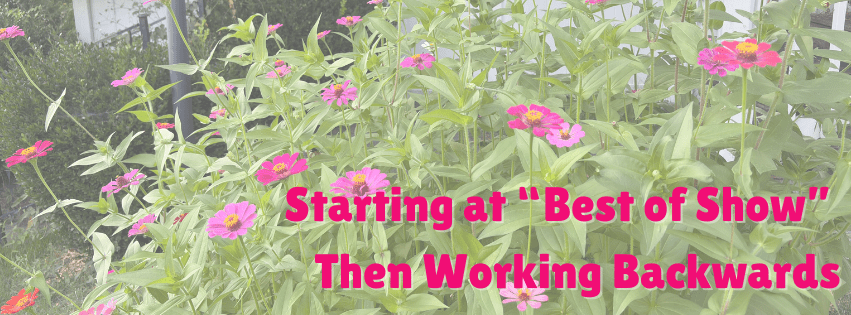
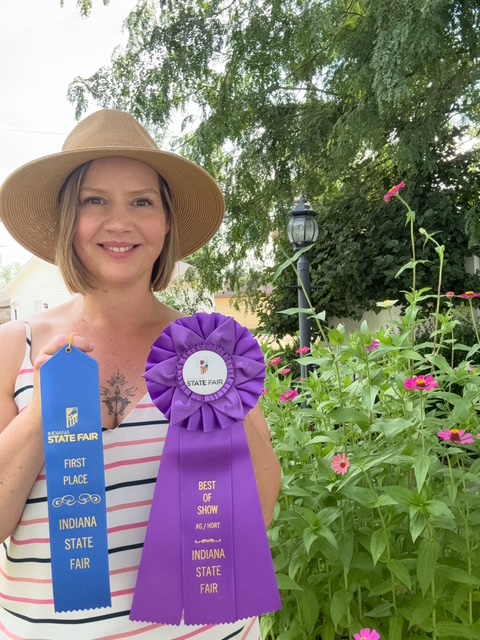
No one was more surprised than me when the zinnias I grow lovingly in my backyard won a blue ribbon and, even more shocking, the title “Best of Show” at the Indiana State Fair.

I only started growing the zinnias in my backyard three years ago, after one of my friends “gifted” me a bit of landscaping, creating the side garden I’d been dreaming of along my back fence.

My Mom and I have an annual tradition of visiting the Indiana State Fair. This most recent acknowledgement is not the first I received at the State Fair, although nearly 30 years had passed since the last time.

Growing up, my Mom was the 4H (“Head, Heart, Hands, and Health”) Leader at my school. This came with some advantages and disadvantages.

I really didn’t take to sewing the way she, a talented seamstress in her own right, did, or wished I would.

And I would get embarrassed by the litany of 4H songs that my Mom would lead at the meetings. These are songs that I have never known anyone else to know besides my Mom and her sisters.

But I still know them all by heart…

“You take a leg from some old table, you take an arm from some old chair, you take a neck from some old bottle, and from a horse, you take some hair, you take some hair. And then you put them all together, with a little twine and glue. I bet I’ll get more loving from a dumb, dumb dummy than I’ll ever get from you!”

Then at the end there she would point directly at some unassuming, pre-pubescent 11 year old boy in the grade below me at school, whose eyes would go wide upon being singled out as an unintelligent heartbreaker by his 4H Leader.

But there were a lot of things I loved about 4H, too. In fact, it’s how I became friends with one of my lifelong best friends, Katie.

And while I might not have liked sewing, I liked being in the fashion shows. And I enjoyed baking, which led to the aforementioned State Fair honors. I think it was the “Black Lake Muffins” that had won. This was my Mom’s time machine of a recipe that zaps me right back to joyous childhood memories of eating fresh-baked muffins every morning on the quaint Michigan lake with my Dad’s side of the family.

So once I started growing the zinnias in my backyard, I noticed myself scoping out the zinnia competition on our annual trip to the Fair. Last year, I made a “note to self” to enter.

The level of communication throughout the process of entering the Floriculture competition left something to be desired. I was consistently confused. I couldn’t find the rules. I couldn’t find the drop-off information. I didn’t know if vases were provided, or if I provided my own. An initial email went unanswered, but a later phone call was, and the helpful staffer or volunteer answered my questions.

The day of drop off, July 30th, I was multi-tasking. I’d forgotten I had therapy that morning, so while I was recounting the previous week of my life to my therapist, I was going over my zinnias with a tape measure and scissors. I had entered four competitions total: one bloom under three inches, three blooms under three inches, one bloom over three inches, and three blooms over three inches. So I needed to find the best eight. During the selection process, I lost confidence. Especially in the three blooms over three inches category.

I placed them in their vases and packed them up to travel to the Fairgrounds. Once inside the Fairgrounds, I had only a vague idea of where I should go, and wound up parking along the Midway with my blinkers on.

When I entered the colosseum, I was told that they supposedly sent out tags for us to mark our own entries. Like every other step along the way, I had no idea, but the very kind people working the check in were able to print off copies for me.

I was still feeling less than confident, but I was happy when I pointed out some unique coloring on one of the zinnias I had entered in the three blooms under three inches competition, and the volunteer gave a genuine “oooooh!”

A few days later, once the Fair had begun, I looked online for the results, and was confused (again). The results said “2025”, but I wasn’t seeing my name anywhere on any of the lists. Nor was I seeing the results for 1st, 2nd, or 3rd place. (Frankly, I didn’t realize that “Best of Show” was even a possibility.) So while I questioned whether or not I had even entered the contest correctly, I just assumed that my entries had not been recognized in any of the categories. And I made peace with that.

After all, the true source of joy from my zinnias doesn’t come from external recognition, but from the careful tending, watering, cutting, arranging, and eventual deseeding and replanting I do each year. The joy is boundless because between the blooms and the seeds they produce, they give me a sense of infinite abundance.

So you can imagine my surprise a couple days later when my friend Anna sent a video of my three blooms over three inches entry, marked with both a blue 1st Place ribbon sticker AND a purple ribbon sticker marked “Honor”. I HAD NO IDEA. I hadn’t received an email, a phone call, nothing!

So I looked back at the results page that had been confusing me a couple of days before, and to my own shock, at the top of the category listed: “Floriculture Division – Zinnias – Award: Best of Show” followed by my name! I couldn’t believe it! Again, I didn’t know that was even possible.

The first person I called was my Mom. The second person I called was my Aunt Nancy.

I had always admired the abundance of zinnias that my Aunt Nancy had been growing on and around our fifth generation family farm in Central Illinois. Aunt Nancy and my Uncle Bruce were high school sweethearts. Uncle Bruce was my Mom’s youngest brother. He died very unexpectedly at age 59, in 2013. So it was a pretty sudden shift from the fifth generation to the sixth, with my youngest cousin Ben now tending to both the land, and the community.

One visit, Aunt Nancy had given me a bag of those zinnia seeds, and at first I wasn’t sure what to do with them. Until my friend gifted me with the side garden, I really didn’t know where to plant them. So they sat in a ziplock bag for a year or two.

When I did plant them, shortly after Mother’s Day, three years ago, I could never have guessed the joy they would bring to my life. I had no idea they would thrive like they did in my back yard, enticing bees and butterflies to dance and flutter around their blooms all summer, and most of the fall. The flowers suddenly were the anchor of a new ecosystem in my backyard, an ecosystem that very much includes me. In fact, it’s hard for me to say exactly where the zinnias end and I begin. They feel like a part of me.

So after things started to settle down from that “holy shit! I won!” moment, I started to ask myself “Why?” and “How?” Out of the four categories I entered, I didn’t place or receive an honorable mention in either single bloom categories. I did receive an honorable mention in the three blooms under three inches (the ones with the pretty coloring).

So how on earth did my entry in the category I felt least confident in wind up being selected by the judges as the best out of every zinnia in the competition?

I was perplexed, so I took it to ChatGPT. Basically: “Hey Chat, why did these three flowers win best of show?”

It started to explain to me some of the qualities that judges look for in floriculture competitions, something that I would have been wise to explore PRIOR to submission. 

It said they look for vibrancy (the bright pink meets that mark), uniformity (something that I thought was a disadvantage when I turned in three nearly identical blooms), and then things like health, structure and strength.

I started to realize that this all had something to do with my own instincts, and the relationship I had with my zinnias.

Then I asked: “Do you think it has anything to do with the fact that I brought my own vase?”

Chat said that it’s “very likely” to have had an impact because presentation matters. So it wasn’t just about the quality of the blooms, but the overall aesthetic, too.

Again, instinct was at play, because it would be very much unlike me to leave the vessel of my zinnias to chance. 

With more time for this exciting win to settle, other aspects of my relationship to my zinnias started to make more sense. Like how every year, following the instructions of Aunt Nancy, I started drying out the flowers and deseeding them to plant the next Spring.

The first time I did it, I was terrified that I would do it wrong, and lose this legacy line of zinnias. But that next Spring, they bloomed again, and I knew that whatever I had done worked. With each year of planting more and more zinnias, I reap more and more seeds. I save every single bloom, especially those that I cut to bring inside. And I keep separate the seeds from my inside bouquets from those that remained on the stem.

So inadvertently, I’ve been selectively breeding the zinnias that I’d chosen to brighten my home with pink bursts.

But then I started thinking about the heritage of these seeds. 

I don’t just cultivate zinnias, I cultivate a meaningful relationship with my ancestors. These ancestor acknowledgements started with one of my teachers, Ashley, but deepened through my own practice, honoring, and my understanding of my nervous system.

From my work and studies, I know that my nervous system is not just mine, but something that has been passed down to me. My nervous system, wired for survival and recovery, has been inherited through the DNA of my parents and every ancestor of mine since the dawn of humanity – and millions of years before. So when I say something like “writing is in my blood” from my Dad, that’s not a stretch. And so maybe there’s something inherited about these zinnias, too.

Just as I do now, my Aunt Nancy had cultivated these seeds year after year. But they weren’t growing just anywhere. They were growing on the rich, fertile, black Illinois soil that my family has been farming for over a Century. The land where my Mom grew up.

But when I called Aunt Nancy to tell her about the “Best of Show” nod, she told me that she had inherited the seeds as well, through a favorite relative of hers through her father, Alice Gorden. She also told me a story about a day when she went to visit Alice, who was elderly, to find her on the floor. She got down on the floor with her and Alice asked her if she was “Helen Louise”.

Helen Louise was my grandmother, though I don’t have any memory of her because she died suddenly of a heart attack when I was six months old. She’s also my namesake… my middle name is Helen.

And while I didn’t know her, I look at her picture every day.

I didn’t realize it until more recent years… the unimaginable pain of losing your mother right after having your first child. Right when you need your Mom the most. I don’t know how my Mom managed, because this girl (me) was completely dependent on her for life, and had no idea or sympathy for what was happening.

But something I think about a lot is this: My Mom is able to see her Mom in me… the physical features, the personality traits, but I’m not able to recognize those traits in her.

Aunt Nancy said that she was honored that, in that moment on the floor, Alice would associate her with Helen Louise. She was a pillar of her community, and always willing to step up to help someone in need. This is a quality that rubbed off – if not inherited – on all who knew her, or so I hear. 🙂

Who knows where or how Alice got the seeds, but I sure would love to know. 

Still… the seeds have been passed down through generations, and nourished on ancestral land. They were already very special before they ever ended up in my possession. 

And I suppose knowing how to take care of them, how to be in relationship with them, and how to help them thrive is something that came naturally to me. After all, I come from a long and impressive line of 4Hers. And cultivating seeds into joy is about as good of a use of our hands, head, heart, and health that I can think of.
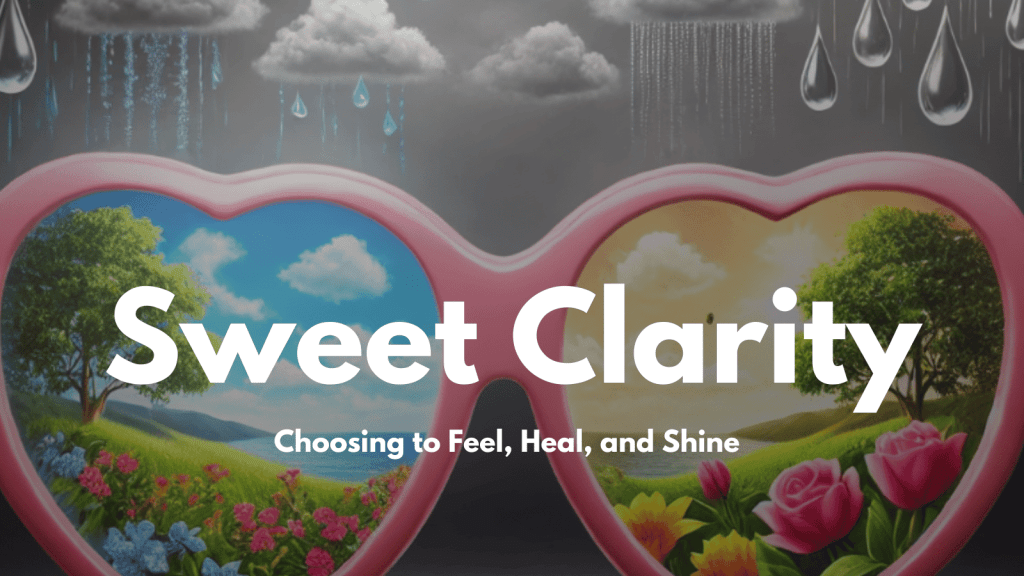
Sweet Clarity: Choosing to Feel, Heal, and Shine

Today marks 100 days with no alcohol! It’s probably the 3rd or 4th time I’ve hit this milestone. I don’t consider myself “sober”. I don’t like that word very much. And at this moment, I don’t foresee alcohol in my future. But you have to know yourself, and I know telling myself “never” or “forever” doesn’t work for me.

I’ve never considered myself an alcoholic. I never hit a rock bottom. My choices while using alcohol never negatively affected or impacted other people. If anything, I become more bubbly and pleasant with a couple drinks in me.

But there came a point, about six or seven years ago, when I realized that I couldn’t remember the last time I had gone a day without two or three glasses of wine. That pattern settled in without me realizing it. Numbing had long been one of my ‘go-to’ responses to a series of traumatic events in my teens and early twenties. As a young adult working in the toxic and hard-partying environment of the Indiana Statehouse, alcohol-fueled evenings became the norm. In 2012, I went through a challenging divorce while managing a Congressional campaign in Southern Indiana, and the two to three glasses of wine a day became a balm.

Then I began my career in public safety. I fell in love with the field, but I went from living in the green to living in the orange, a heightened state of stress and vigilance. Suddenly, I was ultra aware of every bad thing happening in my community, and as the sole Public Information Officer, I was on call to the media 24/7/365.

The first time I took a break from alcohol was like a punch in the face. Without my rosé-colored glasses, I looked at my life and I did not like what I saw. I didn’t like how I was spending my time, I didn’t like how I looked, I didn’t like how people were treating me. I was neglecting my health, my passions, and my boundaries.

I was going through a program called “Hip Sobriety” that I’d stumbled across on Instagram. The founder, Holly Whitaker, eventually wrote a book “Quit Like a Woman”. I’d highly recommend it.

And while I didn’t stay “dry” beyond that 8 week program (it had never been my intention)… my eyes were open, and I couldn’t unsee what I saw.

Three things all happened around the same time. I stopped drinking for the first time and began a long conversation with myself about my relationship to alcohol. I found my current therapist! I don’t know what I would do without her. And I signed up for Yoga Teacher Training. It was something that I had always wanted to do, but it was never the right time. After the “sobering” view of my life, I decided that I was doing it, and nothing was going to stop me. The rest is history.

Obviously, teaching yoga has been deeply transformative for me. I wasn’t sure if I wanted to actually teach at first. My early motivations were more along the lines of education. I knew I wanted to write and talk more about spirituality. Being a yoga teacher could be a platform for that. What I wasn’t expecting was for the philosophy and energy systems behind yoga – aspects of the practice that are often overlooked in Western yoga practices – would begin my journey to healing deep-seated trauma. I also didn’t realize that this healed—or continually healing—version of myself, who once dreamed of sharing these transformative practices with my colleagues in public safety, would soon have the opportunity to create meaningful change in my community and present these practices (and more!) on stage at international conferences.

When I talk about my work, I often tell people that I have to pinch myself that this is really my life. And that’s mostly because this was NOT THE CASE just a handful of years ago.

Over the past several years, there have been times when I have slipped back into old habits, particularly when I’ve been in mourning or when life has just been kicking my ass.

But when I rededicate myself, not to sobriety, but to CLARITY, to feeling all the feels without turning away or numbing, it reminds me of my wholeness, my inner worth, and what I (and all of you) deserve: to wake up in the morning ready to make a difference, and to whole-heartedly reject the ideas, the people, and yes, the substances that dim my inner light.

The Butterfly Effect: On Wanting to Be Something You’re Not

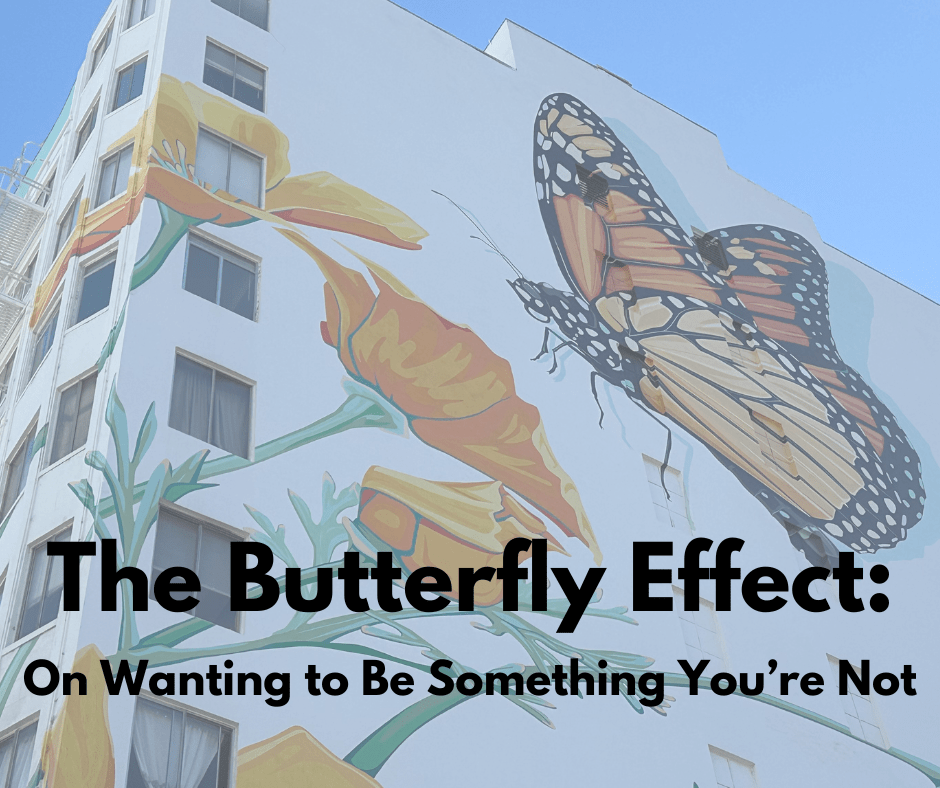
The Butterfly Effect: On Wanting to Be Something You’re Not

I’ll blame the terrible, horrible, no good, very bad summer I had for this delusion I had of wanting to become a butterfly.

Not an actual butterfly, of course. I know I’m not an insect. But I’d been in such a dark place – from a severe infection on my leg, to losing my sweet, sweet dog Oke, and sustaining injuries in a car wreck that totaled my car- that I saw a light at the end of the tunnel in the form of getting accepted into an exclusive training program.

I had it all planned out. I would travel across the country, I’d knock the socks off the other students and instructors with my experience, my passion, and my knack for teaching. When I came back, I’d re-emerge from the dark cocoon of grief, illness, and injury, brighter, shinier, and ready to make an enormous impact by sharing my new skill set.

But that’s not what happened. Not at all.

Instead of the transformation I’d hoped for, I came back sleep-deprived and disillusioned, a rough version of myself. I even lost four pages of raw reflections I’d written, which I thought might be for the best. 

As I traveled home, inspired by one of my favorite podcasts – “The Emerald Podcast” – I wrote out a long plan for a detox, and a reset. The primary focus of this period of cleansing and renewal would be getting enough sleep, a subject matter that I teach, but know from a lifetime of experience that it’s easier said than done.

Slowly but surely, I started to feel like my normal self again, and for the second time that summer, I pulled myself up out of a deep, dark hole.

The evening I returned home from San Francisco, I met up with one of my best friends for dinner, and over our conversation, it dawned on me: I didn’t need to become someone different. I just needed to come back to myself.  I’m not a butterfly. I’m Katie Carlson. Purposeful, passionate, playful, resilient, unapologetic Katie.

It’s hard to blame myself for wanting life to be different, but I was failing to utilize one of the most powerful tools in my toolbox, me. My truest, most authentic self.

Like many people, particularly women, I struggle with “imposter syndrome”. As a civilian working in the field of law enforcement wellness, I feel pulled between knowing that I’m exactly where I’m supposed to be, doing exactly what I’m supposed to be doing, and a sense of defensiveness, feeling I need to prove that I belong in my field.

This sense of wanting to fit in draws me toward certain modalities of healing and wellness because they are more highly “accepted” in the field of public safety. My belief in the power of these more accepted modalities is deeply real. I’ve witnessed them in action. I’ve watched them work, over and over again. But that doesn’t mean I need them to justify my existence.

One positive thing, however, stuck out from the training. Even in a room of incredibly impressive people, folks with unmistakable credentials in the field, when the topic of conversation turned to holistic wellness practices, like yoga, wellness, and breathwork – and it did on multiple occasions – suddenly my credentials were unmistakable. 

Compared to about 64 hours of training in the widely-accepted healing modality, and another 24-30 as a practitioner, my yoga teacher training was 200 hours, and my meditation teacher training was 300 hours. I’ve taught almost 450 hours of yoga, and about 100 hours of teaching meditation. I’ve spent more than 400 hours, just since 2021, in my own meditation practice, and over 18 years, it’d be impossible to guess how many hours I’ve spent in yoga practice, but at least 1,000.

I don’t need to justify my existence, nor do I need to doubt the impact of my work in the field of public safety. The proof is in the pudding.

This whole thing has given me a much higher degree of compassion for people I see trying to figure out who they are, folks who are trying to figure out the truest version of themselves. So long as they aren’t causing harm, I’ll now try to suspend my judgment of them as inauthentic.

I went through a course recently with one of my favorite teachers, Nikki Myers, called “Healing Secrets, Healing Self”, and she would often reference Michaelangelo’s meticulous work on the statue of David in which discussed the pre-existing completeness of the status, noting that he just needed to chip away at everything that wasn’t David.

Our paths to authenticity, more often than not, are a matter of subtraction, not addition.

Over the course of our lives, we pick up a lot of stories. Families tell us what we should value. Political parties tell us how we should vote. Religious doctrines tell us what we should believe. Industries tell us how we should look. Corporations tell us what our goals should be. Social media accounts tell us how we should be doing in comparison with others.

All of this conditioning, all of these added layers, sediment, if you will, cloud our vision of the truest version of ourselves. The self that has always been there, that will always be there. 

I saw an Instagram post recently that said “Two people to impress: Your 5-year-old self and your 85-year-old self.”

So there’s good news, and there’s bad news. The good news is that we can in fact metamorphosize, though the timeline is different from that of a butterfly. We can transform our bodies, our minds, and our souls. The bad news is that you aren’t going to come out on the other side a different person. Yep, sorry, you’re stuck with you.

All of the physical conditioning and plastic surgery in the world can’t change the purity of your child-like soul and it can’t erase the scars that have been acquired along the way. But you can shed all of the things that you are not.

Unlike the metamorphosis of a butterfly, which is brief and linear, human transformation is cyclical and deeply rooted in our previous life experiences. Our transformation is ongoing, and even our truest, and most authentic versions of ourselves can shift and take new forms over time. 

When you are in your purpose, living your truth, being your most authentic self, it won’t matter what anyone else thinks. You might fall. You probably will, but you’ll fall forward. You might get criticized, but it can’t hurt you.

It might take some shedding, some cleansing, some experimentation to find the real you. But you’ll know it when you find it.

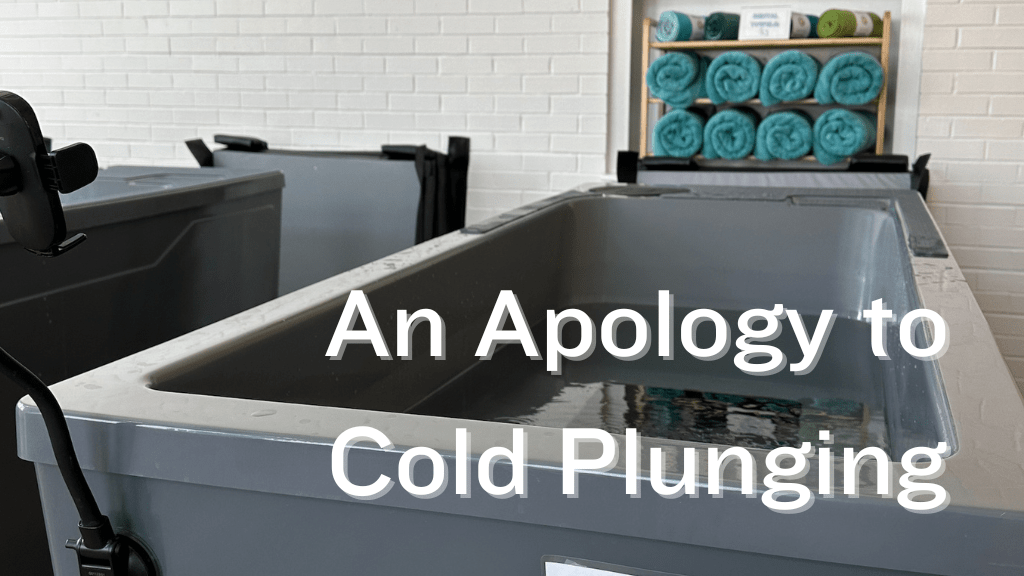
An Apology to Cold Plunging

I can admit it when I’m wrong. And I was wrong about “cold plunging”.

My misperceptions (or most of them) at least came from my heart being in the right place.

This past week, I’ve been in several discussions about the impact that critical events might have on our worldviews, either affirming or denying them. A slightly more casual worldview could also be defined as a personal value.

I’ve mentioned her in other writing, and I’ll mention her again. In her book “Real Self Care”, Dr. Pooja Lakshmin argues the differences between faux self-care and real self-care. Faux self-care includes retreats and cleanses that are out of reach for all but a few. Faux self-care is a narrative that is dominated by a capitalist society constantly reminding us that by buying this or that we can come a little bit closer to being perfect.

Real self-care, on the other hand, is something that no one can give you but yourself, like moving your body in ways that feel good, nervous system regulation and setting boundaries.

A value that’s central to my yoga and meditation practices is accessibility. With some judgment, perhaps, I question anything that can get in the way of a person and these powerful practices. 

Short on time? You can see the benefits in 5 minutes!
Flexibility or body image holding you back? Come to my class! It’s a safe and diverse space. I offer many variations of each pose. Move in a way that feels good to you.
Tight budget? My class is free! Everyone should have access to yoga! You don’t need fancy clothes, or mats. You can even develop a yoga practice from YouTube!

Where barriers between people and these practices exist, I want to be there, knocking them down.

I’ve long heard of the benefits of cold plunging, if not through online courses offered by Wim Hoff, through colleagues of mine in public safety wellness, colleagues I trust and whose opinions I hold in high regard.

But a practice that you need a special tub, and/or bags of ice? Feels inaccessible to me.

Less generous than my worldview that everyone should have access to wellness practices, regardless of their resources, was also a judgment that cold plunging was… I think I’ve called it… “bro wellness”. I apologize for that, y’all. Truly.

Between the special equipment, and the videos with the grunting, I misjudged it as hyper masculinity. But I was wrong.

I’ve been particularly rigorous with my body lately. On purpose! I’ve adopted this credo by Seneca: “The body should be treated rigorously, so that it may not be disobedient to the mind.”

But as I hone in my passion for climbing, and continue on a streak of building strength, steadily climbing (about three times a week), with no injury, I’m testing the limits of my body. I walked into hot yoga knowing my arms were very sore and tired.

Hot yoga is another one of those value-questioning practices. Do you really need to pay for a pricey class, to be in a room over 100 degrees and sweat through every article of clothing you’re wearing to have a yoga practice? No. But dang it if hot yoga doesn’t help my body repair itself, especially for mild injuries and pain. And I just love the teacher, Patrick. He teaches yoga in a way that’s accessible to any level of yoga experience, from a beginner to a long time practitioner, like me. So it checks off my “accessible” value box.

The studio had just opened a “cold therapy” room across from the hot yoga room. Two weeks ago, I kind of rolled my eyes. This time, I eyed it and poked my head in thinking… “that might feel good”. Before yoga began, Patrick shared that he was going to plunge after class and that we could do it together. And that was that. I signed up for a plunge following class.

There was one more obstacle, which was that including rinsing off in the shower after the hot class, you needed to be wearing clean plunging clothes or a swimsuit. It’s a rule with which I whole-heartedly agree, but wasn’t prepared for. $20 later, with a swim suit off of the clearance rack, I was ready. 

I chose the coldest of the three plunges because “why not”. The temperature was set at 40 degrees. Patrick set a timer for three minutes on his phone, and we got in.

I knew what I had to do, which was focus on my breath. And from the moment I entered the water until those three minutes later, I practiced straw breathing. 

I teach straw breathing all the time. To hundreds of incoming law enforcement personnel every year. To the public. To inmates. To colleagues recovering from critical incidents. To other peer support team leaders across the country. I jokingly called it my “Katie, get your shit together breath”. Straw breathing is what I know I can turn to for self-regulation.

And in the plunge, straw breathing worked. Perfectly. Under the somewhat bizarre and unnatural conditions of sitting in a very cold bath, I kept my cool. While I could deeply sense the bitter cold on my skin, the contraction in my muscles, and felt so much activity in my body’s reaction to the cold water, I kept my heart rate under control. I kept myself out of fight, flight, and freeze. 

After the three minutes was over, when feeling slowly crept its way into my body, a sense of joy sunk in. Some call it euphoria. I just felt very, very alive. And happy. Happy because this technique I teach so often to so many people works. I already knew that it worked. I use it all the time. People frequently tell me about how it has helped them. And while I encourage practicing straw breathing, or any type of breath work practice, regularly, so that it kicks in naturally, I can’t imagine a better way to send your nervous system into high gear, and practice bringing it back into regulation better than cold plunging.

So this is my formal apology to cold plunging: I misjudged you. You are not “bro wellness”. You are a very, very practical tool for training our ability to self-regulate our nervous systems. I just wish everyone I teach nervous system regulation skills could have access to this method of practice. 

This is where we run back into that matter of accessibility. Maybe I’ve had my sight set on the wrong targets. I’d been judgmental about the existence of options, like cold therapy and fancy wellness spaces, when the real problem is the aforementioned capitalism. The problem is a system that sucks billions of dollars to the top few, and leaves our communities struggling to fund public services, community investment, and comfortable wages for the men and women who take on the most challenging work. So while it’s both my job and my passion to figure out how to provide access to wellness services, it’s our job as a community to remember that next time we’re fighting each other, up regulating our nervous systems because it’s us versus them, that the billionaires and corporations are glad we’re distracted, unhealthy, unfulfilled and ignoring them as they laugh, “no wellness for you!”

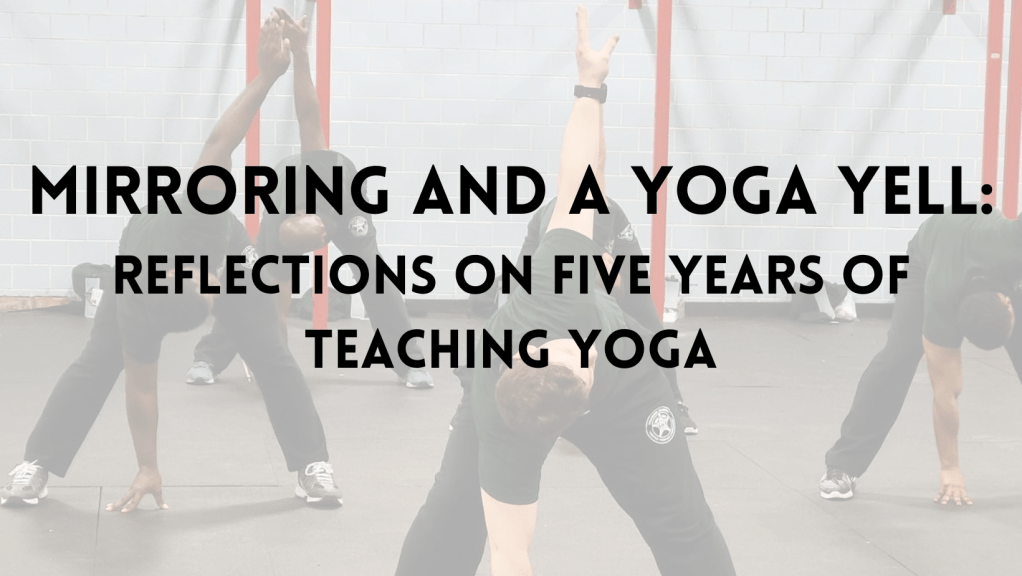
Mirroring and a Yoga Yell: Reflections on Five Years of Teaching Yoga

Monday, March 4th, 2024 was the five year anniversary of my Community Yoga class in Garfield Park, which means it was also my fifth anniversary of being an actual yoga teacher. I completely missed the anniversary, despite Community Yoga falling on a Monday and on the exact day. 

Our class – and I say “our” because it’s truly a class that belongs to our community – has bounced around to several locations. It began in the Burrello Family Center. About a year in, we were shut down due to COVID, we started back up outside that Fall, we took another pause, started back up outdoors that next Spring, moved inside to the Garfield Park Arts Center, first upstairs, and then downstairs, moved back outside, and now we’re at the Burrello Center again.

You know the saying “the more things change, the more they stay the same”? It was surreal coming back to the Burrello Center. I could feel the flood of terror I felt as a first time yoga teacher wondering what the hell I had gotten myself into, and arriving nearly 45 minutes early every week to walk around the room in circles repeating mantras to myself.

I almost didn’t go through yoga teacher training for one main reason. I’m not great at distinguishing my right from my left, or, it takes considerable thought, and sometimes looking for the “L” shape in my left hand. As a navigator, I drove many drivers crazy by simply pointing and saying “this way” or “that way” or “left, no I mean right!”

It didn’t stop me, though, because I didn’t think that I’d actually want to teach yoga. In fact, I’d convinced myself of that. “It’s just a way for me to get some additional education in the spiritual realm,” I’d say. “I’m mostly just interested in learning more about the philosophy of yoga. I love philosophy!,” I’d reason.

Well, the joke’s on me. 

I didn’t love teaching at first. It terrified me. I had imposter syndrome. I questioned my own authenticity. I picked apart my classes. I picked apart my appearance in the front of the classroom. Ironically, I didn’t start to love teaching until after the pandemic hit.

In the earliest days of the lockdown, I began “Yoga Lunch Breaks” on Facebook Live. A classic millennial, I felt a little more comfortable with a screen between me and my audience. But it became a lot more than that. When people were scared of them and their children and their parents of getting sick and dying, unable to leave their homes or obtain household basics, like cleaning supplies, I learned what it really meant to “hold space”. While acknowledging the fear and uncertainty in the world around us, I had the opportunity to create an accessible practice for people to connect to their body and their breath. It meant a lot to a lot of people, and it still gets brought up from time to time.

Teaching full length classes online, along with the Daily Lunch Breaks, helped me grow more confident as a teacher, and by the time Community Yoga was able to start back up outside, I was hitting my stride.

I had intentionally chosen to wait until I felt comfortable teaching yoga before requesting to teach it at the Marion County Sheriff’s Office Training Academy. I did not want to “practice” on incoming law enforcement personnel. I wanted to know that I could deliver them high quality classes. But by December of 2020, I was ready. One of my dear colleagues, now-Lieutenant Jason Kirlin, who oversees all physical training at the MCSO Academy, attended that first class for Detention Deputies, and immediately included yoga in the physical training of the next Deputy class. Without his belief in the benefits of the practice for law enforcement, I can hardly imagine that I would be in the position that I am today.

By June of 2021, I was teaching at the Indiana Law Enforcement Training Academy, as well as the Indiana State Police Training Academy, thanks to my friend, and an incredible trainer and leader in public safety wellness, Troy Torrence.

The rest, as they say, is history. Once I started teaching incoming law enforcement personnel, I never stopped. I also don’t shut up about it.

Another opportunity landed in my lap during the Summer of 2021. I had the opportunity to go through Mindfulness and Meditation Teacher Training through the Engaged Mindfulness Institute, a training organization under the same umbrella of the Center for Mindfulness in Public Safety, through which I met Troy, and several others who are now good friends.

Like the concern about knowing my left from my right, I had concerns about becoming a meditation teacher, too. Primarily, that I didn’t meditate that much. The opening “silent retreat” via Zoom almost killed me. I’d gone from meditating sometimes for about twenty minutes to being expected to meditate for hours a day. If I hadn’t been home by myself, I might have killed someone. I thought I had made a big mistake.

But as the training went on, I was soothed by a heavy emphasis on philosophy (“I love philosophy!”). Then, as we got into the techniques of teaching, not just teaching, or guiding meditations, but facilitating, something clicked in me. For years before I had been a volunteer at Girls Incorporated of Greater Indianapolis. I taught hundreds and hundreds of girls, usually between the ages of 9 and 11, in a variety of life skills, like conflict management and media savvy. I loved teaching the girls, but eventually parted ways with the organization. For a while, I felt that I didn’t have much to show for that investment in time (hundreds of hours over eight years). But as I began to facilitate meditation courses, I realized that not only did I have hundreds of hours in facilitation practice, but that training willing or required (in the case of recruits) adults is WAY easier than 9 to 11 year old girls. That transference of skill was such a blessing.

I’ll admit it. While I LOVE teaching yoga, I love teaching mindfulness and meditation even more. I think it’s a matter of accessibility…something that has always been very important to me. So while it would be unreasonable to expect everyone to love yoga (although I try to teach it in a way that makes it feel as good as possible), everyone, and I mean everyone, can benefit from mindfulness and meditation.

It makes me giggle because I remember in yoga teacher training when my teacher, the beloved Marsha Pappas, warned us against using a “yoga voice” or using an unnaturally soft, wispy voice to teach yoga. She said to just be ourselves. It’s easier said than done. When you have a room full of people who come with an expectation of leaving more relaxed than when they arrive, you want to sound soothing. However, when I teach yoga and meditation at the Indiana Law Enforcement Training Academy, it is me, in a gym, and about 150-160 cadets. I don’t have a “yoga voice”, I have a “yoga yell”. That same “yoga yell” carries outdoors for our Community Yoga class. And yet, somehow, people, whether they are in the Park, or at the Training Academy, still tend to leave a little more relaxed than when they came. So there must be something to that sense of authenticity.

And how are things going with my left and right, you ask? Well, in the past year or so, I have taught myself how to mirror, so that when I’m facing a class, and calling out for them to step their right foot forward, I’m stepping my left foot forward, mirroring them. I’m still surprised I can do this, but I can observe the considerable impact this skill has on my effectiveness as a yoga teacher and demonstrating the poses, especially to those totally new to yoga. But sometimes I still have to shout out, “left, no! I mean right!” and vice versa.

All this is to say, I can’t believe I’ve been teaching for five years. I can’t believe it’s ONLY been five years. It feels like a lifetime. I’m grateful to so many people… my many teachers, my friends and colleagues at the Training Academies, and every student (probably close to 2,000) who has ever trusted me with a configuration of their body or their breath. And I’m so excited to see where it goes from here.

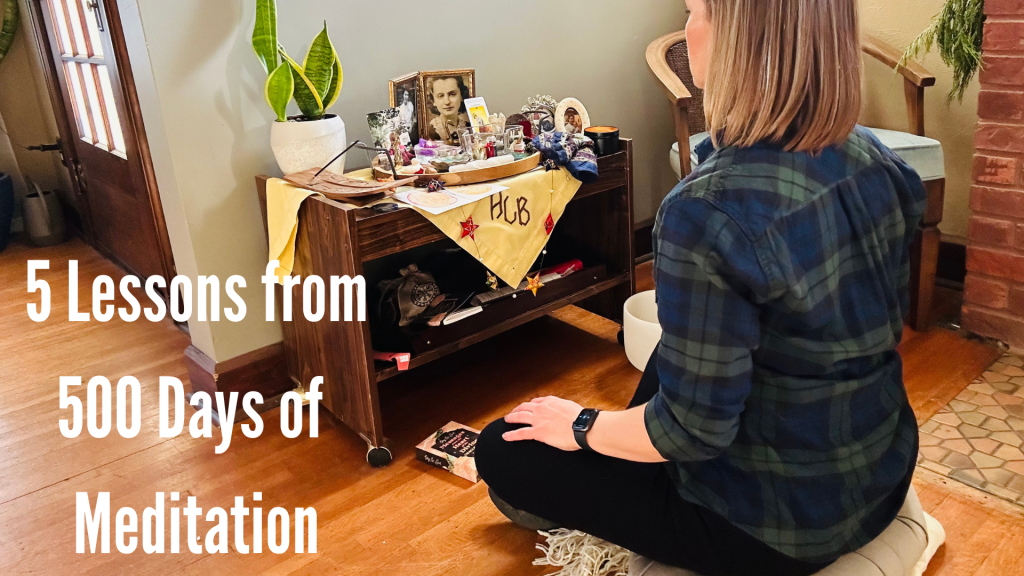
5 Lessons from 500 Days of Meditation

I’ve been waiting to write about meditation. First, I passed the point of 100 consecutive days, and though the benefits of the daily practice were practically bursting out of me, I thought that 100 days wasn’t impressive enough. I’ll share at the one year mark, I thought.

The one year mark came and went amidst a lot of chaos, chaos that was softened by leaning heavily on my meditation practice. But with no time to write about it.

But on December 12, 2023, I hit 500 days of consecutive meditation practice! 

Mindfulness meditation practice has made a huge impact on my life, but I’m going to boil what I’ve learned over 500 consecutive days of meditation down to 5 lessons.

  1. Be Your Own Biggest Cheerleader. If there is one biggest impact that mindfulness meditation practice has had on my life, it’s this. I spent decades of my life beating myself up. Whether it be harshly judging my actions and/or my appearance, or comparing myself to others, I was not nice to me. But in meditation practice, there’s an opportunity to change that running narrative. Sometimes people think that meditation is about being able to concentrate for a certain amount of time without being distracted, so they think they “aren’t good at it”. But meditation is about recognizing when your mind wanders, and gently, with kindness toward yourself, bringing your attention back. That sense of kindness toward myself… replacing the “Katie, you suck at this” with “That’s okay! Just bring your attention back!” seeped into the rest of my self-talk. Over time, I’ve gone from my own worst critic, to my own biggest cheerleader, and the cheer is: “It’s okay! Keep going!”
  1. Show Up for Yourself. Sometimes self-care is described as “putting on your own oxygen mask first”, which is apt, especially if you frequently put the needs of others above your own, or are pouring from an empty cup. But the truth is that service to others isn’t the only reason that we don’t give ourselves the self-care we need. Stress and overwhelm can make us forget about our true capacity to show up for ourselves. We may also forget that showing up for ourselves doesn’t have to mean finding an hour to take a yoga class, or a twenty minute meditation. My teacher, Fleet Maull, taught that in mindfulness, we must “take our seat”. That may mean taking our seat on an actual meditation cushion, but it also just means showing up, and arriving at your practice. The secret is that even if you just show up for yourself for one minute, or five minutes, “It’s okay!” (see above). 
  1. Just Breathe. Our breath is so important. When we can control nothing else around us, we can control our breath. And while we’re lucky that we don’t have to think about each breath we take, our bodies SAVOR the intentional assistance with our breath. There is a lot of anatomy and neuroscience behind breath work, and why it’s so effective, but I’m not going to rehash that here. But I joke as I’m teaching breath work, yoga, mindfulness, meditation, and other resilience practices to public safety personnel, “Have you noticed that we are mostly just breathing?!” As you read this sentence, take three big, deep breaths. Then notice how you feel. Your body and mind will thank you.
  1. Actively Direct Your Energy. This might tie with softening my self-talk for the biggest impact that mindfulness has had on my life. Or they just go hand-in-hand. It’s pretty simple, actually. We can passively let life happen to us, or we can make choice after choice after choice to spend our energy on the things that are important to us. But first, it helps to be crystal clear about what’s important to you. Make a list. Mine is something like: family, friends, my dog OkeDoke, my personal health and self-care, my work, my hobbies (like climbing and teaching), serving my community, my relationship with God, and all people, beings, and things. Then make another list. What gets in the way of those things that are important in your life? We practice mindfulness meditation not so we can qualify for the Best Meditator Ever Award, but so we can strengthen our muscle of mindfulness – that noticing of when our mind has wandered, and gently bringing it back – so that we can live our lives with our energy and attention directed at the things that really matter. Recognize what distracts you (phones, meaningless drama, bad habits, etc.), and direct your attention and energy back to the things on this first list. And guess what! If you get distracted, and have to start over, “It’s okay!”
  1. You Can Always Start Again. As the Japanese proverb, and many other iterations go, “Fall down seven times, and get up eight.” Whether you’re directing your attention during a five minute guided meditation practice, or implementing a new self-care routine, it doesn’t matter how many times you have to start over, as long as you start over. It’s totally okay.

Bonus: Some of my favorite authors, like Gretchen Rubin and James Clear, write about “habit stacking”, one of the most useful methods I’ve used to implement healthy habits. So while I hope to have convinced you to consider adding a mindfulness meditation practice to your life, think about what you are already doing. Do you pull into a certain parking spot each day? Stack a 1 minute mindfulness practice onto parking. But another option is this: Stack your mindfulness practice with a gratitude practice and/or prayer. They go hand in hand. And I won’t promise much, but I’ll promise this. You’ll never regret taking three big breaths and listing three things you are grateful for.

Start small, folks. My meditation practice took many years, many 21 Day Challenges, many courses, many articles, many apps, and a 300 Hour Meditation Teacher Training to develop – not to mention the past 500 (!) days – and I get distracted during meditation ALLLLLLL THE TIME. I’m always interested in deepening my practice, including extending the length of the practice. But the current length (about 20 minutes daily, followed by gratitude and intention setting) is one that fits well into my morning routine, and is something that I can maintain. It’s been encouraged that I participate in annual silent mindfulness meditation retreats and everything inside of me pouts, “But I don’t wanna”. My practice has lots of room to grow, but for now, it is where it is and that’s okay.

I’m endlessly grateful for the people and organizations who have helped me develop this practice. It started with the Center for Mindfulness in Public Safety, including my teachers and friends Dr. Fleet Maull, Vita Pires, John MacAdams, Julie Paquette, and Robert Ohlemiller. I completed my 300 Hour Mindfulness and Meditation Teacher Training through the Engaged Mindfulness Institute, with the same amazing people listed above.

Hope and Pretzels at 35,000 Feet

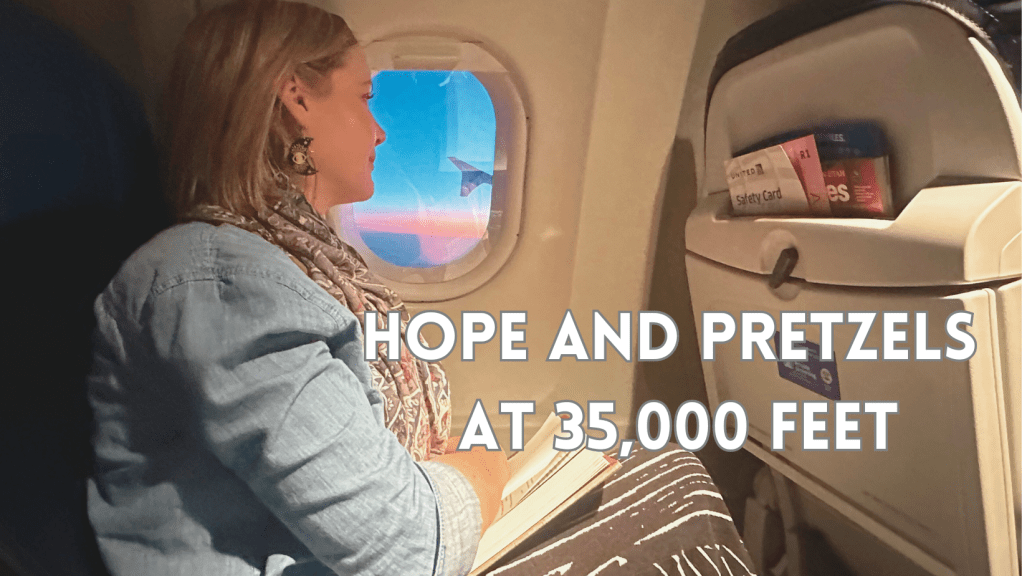
Photo By the Kind Stranger in Row 32, Seat C Who Reminded Me to Take Up Space

At first, it felt like any other flight. In order to avoid snowy weather in Chicago, the boarding process began early, as the pilot intended to depart about 15 minutes ahead of schedule.

As I made my way to my window seat, the other woman seated in my row looked about my age, dressed in a way that made me think that we could be friends. But I didn’t engage. I had my Airpods in, the book “Courage is Calling” by Ryan Holiday in hand, and was just ready to get home. No one filled the seat between us, so as my row mate lowered the middle tray table to set down her Dunkin Donuts beverage, I didn’t judge, but I noticed.

It was upon take off (middle tray table temporarily secured back into place) that I realized this flight was different from others. I was aware that the Pentagon was close to the airport, but as its distinct shape caught my eye from the sky, I got giddy excited. After an evening and two early mornings exploring as much of Washington, D.C. as possible, it’s hard not to grow an increased sense of protectiveness over this sacred place. It’s impossible to stand on the steps of the Capitol Building, and not think about the deadly insurrection that took place less than three years ago. As I flew over the Pentagon, I remembered seeing the smoke, structural damage and 184 lives lost after terrorists crashed a plane into the building on 9-11. 

In both cases, I felt a sense of our resilience as a nation… a very imperfect nation, but a resilient nation, made up of resilient people.

The rest of the flight was spent chasing the sunset westward. I couldn’t take my eyes off it, especially not the deepest red band where the light met the cloud line. I was reminded of a common teaching in mindfulness and meditation that our minds are like the limitless sky and our thoughts like the clouds… impermanent, changing. As I continued this practice of mindfulness and awe, staring out the window, one passing cloud in my mind was the thought of my Dad, who loved the sky, flying, and clouds. With my gaze fixed on the horizon, I started to notice the feeling of overwhelm in my body. My heart began to race, and as a teacher of self-regulation, mindfulness and breath work, I fell back on my training. 

When I teach breath work at the law enforcement academy level, I’ll often suggest to recruits not to wait until things are going wrong to practice breath work. Practice it when things are going well. When it’s a sunny day and the windows are down and your favorite song is on, practice straw breathing then. Try to take a moment of joy and make it better by connecting to your breath. So I did just that. Staring at the sunset, I began to breathe in for a count of four, and out for a count of eight. 

With just a few rounds of straw breathing, my heart rate started to come back down, and I asked myself another question… a question I don’t think we ask ourselves often enough: “Is there anything I can do right now to make this moment even better?”

I was hungry. Earlier I’d been debating whether I should eat the trail mix in my backpack on the first flight, try to grab a bite at O’Hare during my layover, or wait until my flight to Indianapolis, and eat the trail mix then. None of those sounded particularly appealing, let alone joyful.

But when I asked myself that question: “Is there anything I can do right now to make this moment even better?,” I remembered that in my backpack, down at my feet, I had a double Wawa pretzel.

As a kid, I’d get so excited whenever soft pretzels would make it home from the grocery store, and I’ve been Team Soft Pretzel ever since. Earlier this year, when visiting my best friend Kristen in Philadelphia, she introduced me to the Wawa pretzel. This convenience store delicacy captured my heart to the point that I brought 10 pretzels home from Philly. As we were moving stuff around from my backpack to my suitcase to try to accommodate all of the pretzels, so much effort went into getting the suitcase to close and zip that it partly ripped. Oops!

So I was thrilled to be reunited with Wawa pretzels in D.C., and even more excited about having a double for dinner while chasing the sunset.

You have to understand, a Wawa pretzel, especially a double, is not a dainty thing. Wawa pretzels are large and in charge. So as I pulled out this treat and began to tear off bite after bite, I started to eye the lowered tray table of the unoccupied seat next to me. Besides good manners, I don’t know why I asked “Do you mind if I share this with you?” to the other woman in my row because I knew I didn’t need to. This extra space was a gift to both of us and belonged to neither of us. Of course she said “sure!”, and I happily plopped down my massive pretzel/dinner, reaching over for bites while staring at the sky. Then, as I wrestled my water bottle out of the seat pocket in front of me, I set it down in the empty seat.

I was so grateful to my row mate for reminding me that I was allowed to take up space. Especially on planes, I try to be the smallest, quietest version of myself. Mostly, again, because of manners, but this spreading out felt like another big exhale. The pretzel on the tray table and my water bottle on the seat next to me brought me joy. That might sound weird about a water bottle, but it was true. 

Because of its heft, I left my “comfort” YETI water bottle at home, but I brought a Strength Card sticker with me to place on the disposable bottle. This was for two reasons: to remind me to be courageous as I embarked on a new adventure, but more practically it was to incentivize me to make sure that it was the one and only bottle of water I used on the trip. While I love to take up space – physical, emotional, proverbial, etc. – I do not want that space I’m taking to be a footprint of plastic and waste on our planet.

With a nourished soul and belly, and a time to just “be” and reflect over the previous couple of days. I was able to feel more deeply into why I had been in a somber mood, a mood that made me feel like I wasn’t showing enough gratitude for the incredible opportunity that I’d been given, which in turn, made me feel worse.

I had mentioned to a couple of friends that I was feeling lonely on Monday night, despite having spent the morning doing whatever I wanted, and the afternoon around a group of people who are all working to make the world a better place. But what I was feeling wasn’t loneliness. I’m by myself quite a bit, actually, and don’t mind it at all. I then correctly identified what I was feeling as melancholy. 

In an essay I wrote earlier this year about my travel anxiety (we’re coming full circle), I mentioned Brené Brown’s important point that in order to access the support you truly need, you have to identify what you are really feeling. Loneliness might be helped by reaching out to a friend or a phone call with my Mom. Brown talks about the feeling of “bittersweet” in a March 2022 Facebook post and said that her “bittersweet state of mind is not about perpetual sadness or melancholy. In fact, it is the source of my joy, my gratitude, and my hope. I have a very clear understanding of pain and sorrow and loss, and the reverence I have for what is hard makes what is sweet and good in life even sweeter. These dichotomies – joy through sorrow, hope through struggle – are the crux of bittersweet”.

I was in Washington, D.C. with an invitation to participate in visioning exercises and discussion on how to expand something I’m REALLY excited about, the Science of Hope, to the law enforcement and public safety communities. The Science of Hope aligns with every aspect of wellness and resilience building that I study, believe in, and do my best to support or offer my colleagues in public safety and beyond, including Critical Incident Stress Management (CISM), Mental Health First Aid, QPR (Question Persuade Refer) Suicide Awareness and Prevention, Crisis Intervention Training, Brain Science (Science of Stress), Breathwork, Mindfulness Meditation, and Yoga. And more. It aligns with all of it.

A thread that runs through all of these modalities of wellness is trauma, including trauma resilience, trauma mitigation, trauma recovery and trauma healing.

And without fail, each time I take a deep dive into these or related topics, it has a tendency to kick up a lot of dust. Having endured a series of three cumulative traumatic events as a teenager, more in my early political career, and the exposure to over a decade of secondary trauma working in public safety, I am a trauma survivor. But I’m also a post-traumatic thriver.

So as I work with individuals and groups – locally and throughout the world – to help others recover from traumatic experiences, I feel sadness for my teenage self who desperately needed this help, even though our current understanding of trauma had been far from developed, yet so grateful for the practices and resources that I did have and find. I feel anger for the decades of damaged and misplaced self-worth I carried around, and gratitude for the person I am today. I feel devastated for the history of unaddressed and ongoing trauma that has effected humanity for the worst (war, genocide, slavery), and I’m grateful that we are starting to understand trauma and its effects on a medical, psychological, personal, relational and societal level. And while my heart breaks for so many people who have faced trauma much more severe than mine, I’m grateful to be in a position where I might be able to help even just one other person.

Working with trauma is not easy. It is not for the faint of heart. I keep visual reminders of courage and strength nearby because I need them to do this work.

Earlier in the day, as I was packing my bags for a day full of meetings and the eventual flights home, the zipper of my suitcase broke completely. I called the front desk to ask if they had any duct tape. They did, and brought it to my room. I then wrapped duct tape a few times around the center of my suitcase, placed a few pieces at the bottom, and carried on. Eventually, I bought a luggage strap to replace the duct tape around the center, but kept the tape at the bottom for fear of something shifting and spilling out. 

As I stared out at the enduring sunset, I felt there was a lot in common with my busted, taped-up suitcase, still sufficiently rolling around the city and protecting my belongings, and the work I do to help others find their path to trauma healing while managing the messy and non-linear path of my own. But while my suitcase’s scars were visible, the scars of trauma are often invisible.

Almost everyone has some trauma. Some people more than others. Some more apparent than others. But that’s why it’s so important to understand. When we begin the brave and courageous efforts to examine and lean into our own trauma (if you are reading this, I hope it’s not that much), we can gain a sense of compassion for almost every other person around us, even those who have wronged us. Trauma work is bittersweet… filled with so much sorrow and so much joy, so much struggle and so much hope.

A natural response to trauma is hiding away from the world and withdrawing from the people we love. And yet, some of the best ways to build resilience to and recover from trauma is to stay connected to the people who matter to us (hint: strangers can matter, too). That’s because trauma affects us all, to one degree or another. None of us are in this alone, and though we may have to summon all the strength and courage we can muster, there are many resources available for help.

As we neared Chicago, and I was writing this essay in my head, I knew what would be the perfect picture. But I couldn’t do it by myself. Still inspired by her own taking of space, I asked my row mate for a favor. I said: “I’m a writer and I’m working on a story about this very moment. Would you please take a picture of me leaning against the window?” She was happy to do it, and as she did, she also marveled at the sunset as it showed up on camera through the plane window.

The final moments of the flight were bumpy, but I reminded myself of the impermanent nature of the weather. I noticed our plane weaving in and out of clouds, and thought that no one wanted to avoid turbulence as much as the guy flying this thing.

Clouds are inevitable. Weather is inevitable. Pain is inevitable. Sorrow is inevitable. But limitless compassion is possible. Healing is possible. Connection is possible. Hope is possible. Joy is possible.

The Joy of Falling

The sport is indoor rock climbing without rope, or bouldering, but I’m just going to call it climbing.

It wasn’t something I had been longing to do. I had heard of North Mass Boulder, but mostly because I would hear yoga friends talk about yoga classes there. I really had no inclination to go.

But my friend Meg had mentioned it a few times, and offered to take me as a guest. We made plans to attend a yoga class and then climb. 

When I arrived at the gym, my eyes must have looked like a kid in a candy store. During the yoga class, all I could think was, “I can’t wait to climb”. And when we almost didn’t because Meg had a lot of school work to attend to and hadn’t brought her climbing shoes, I momentarily panicked. But we both rented shoes, and at the completion of my first, beginner-level route, I was hooked. 

Over the several months I’ve been climbing, the list of reasons why I love it keeps growing.

The first reason I fell in love with it was that it felt like pure play. It still does. As a kid, there wasn’t a tree, or a combine, an attic stair I wasn’t eager to traverse. Other than emergency preparedness in the chance that I should have to hang onto a bridge or the side of a building to save my life, there’s not much of a point, other than play.

The second reason that I fell in love with it is that I was good at it! I could feel the advantage of my long time yoga practice, my strength, and my flexibility. I felt confident in my body positioning and movement. That if I reach my arm out here, or my leg out there, that it would get me where I needed to go. The more I climb, the more my own body and strength amazes me. At first, I couldn’t believe that I could push the weight of my entire body up by balancing on the ball of my foot on a hold smaller than a tape measure. For most of my life, I’d been doling myself out a lot of body shame and criticism, so this new found sense of body amazement was a welcome change in self talk.

The third reason I fell in love with climbing surprised me. It’s not uncommon to appreciate the “good” pain of a run or workout. But most days, I leave the climbing gym feeling like I’ve been in Fight Club with a wall. I wear the scrapes and bruises on my hands, arms, and legs like badges of honor. I show off my now-calloused hands with pride. What you can’t see are the muscle pulls in my hamstrings, my forearms, and my shoulders. But existing pain doesn’t keep me from going back, and eventually the limping, stiff legs and sore arms give way to definition and toned muscles like I’ve never seen before.

But the true magic of climbing is in falling. And falling again. And again. And over and over again. Sometimes I land on my feet. Sometimes I land on my ass. I almost always cuss. 

When I first started, I’d climb as many routes as I could as fast as I could, as if it might all be taken away from me. In a sense, that’s true. Eventually, each route is taken away. The walls are routinely rebuilt. This is something that I’ve learned to love… especially watching the routes that I haven’t managed to complete go away. It reminds me that, good route or bad route, this too shall pass.

With the wisdom of several months of climbing under my belt, I’m re-learning the importance of rest. Between these falls, instead of getting frustrated, blaming the route setters, or criticizing my own abilities, I’m learning to sit down, catch my breath, drink some water, and work on another route before going back to try again.

When I go back, I use what I learn from my previous climbs and falls. I remember that with a little extra swing here, I can get my hand there… It all adds up. And with a few more tries, I’ll complete the route. And after I do, it gets easier and easier.

My Dad always called me “one tough cookie”. He was a pilot, motorcyclist, and amateur race car driver, and I’d be lying if I said I didn’t inherit his thrill-seeking streak.

But being called “tough” is something I tussle with. For an object, Oxford Dictionary defines “tough” as “strong enough to withstand adverse conditions or rough and careless handling”. I consider the jokes I’ve made over the years about how hard I am on my phones, clothing, purses, shoes, electronics, and cars… From this perspective, I can absolve my own sense of responsibility. It’s not my careless handling that was the problem, it was that these objects weren’t tough enough!

When we are talking about people, “tough” is defined as “able to endure hardship or pain”.

We all face adversity in various forms… some more than others, and different people will respond to similar types of adversity in totally different ways. This is referred to as resiliency, or “the capacity to withstand or recover quickly from difficulties; toughness”. There’s that word again! Is the dictionary implying that resilience and toughness are the exact same? What is my problem with this word?! And why do they feel so different!?

As I scroll past the initial definitions of “tough” as an adjective, describing a person or thing, there’s another definition, describing a “tough” as a noun. This definition “a rough or violent person” is associated with the words “bully” and “brute”. Bingo. Not unlike me with my poor shoes and cars, this definition of “tough” comes with an ability to absolve oneself from causing harm, or the rough and careless handling of others.

How do we be tough without becoming tough? How do we build personal resilience to life’s adversity while remaining open-hearted and kind to others, and even more important, to ourselves?

The answer is simple but not easy. It’s by giving ourselves a million chances. It’s about acknowledging that the adversity we face is HARD and can SUCK! We can get lost and we can forget what matters and we can make mistakes and we can make bad decisions and that’s all OKAY! Because as long as we’re breathing, we have more chances to get it right.

The addendum of “toughness” to the definition of “resilience” aside, my favorite part of that definition is to “recover quickly”. It implies a few things. First, that there is something to recover from… okay… shit happened. Now what? Second, recovery is always possible! Here are those million chances. Finally, if at all possible, recover sooner than later. Life is short. Get back up. Knowing that you are going to fall again, that falling is inevitable, get back up. And get back up. And get back up. 

This is what I love about climbing. There is no victory without falls. The falls, the scrapes, the sprains are just as much a part of the sport as the “sends” (climbing lingo for successful ascents).

Now, I’m not saying you must jeopardize your currently intact skin organ, sprain your ankle or otherwise injure yourself to become resilient. But you can’t just do nothing either! Whether what you are ascending is a climbing wall, a metaphorical ladder, or a very real set of stairs just trying to make it from Point A to Point B, know that if you are doing anything, you are going to fall. Remind yourself that it’s okay, and start over. This is the essence of climbing. (But you really should try it sometime!)