
Month: December 2023
5 Lessons from 500 Days of Meditation
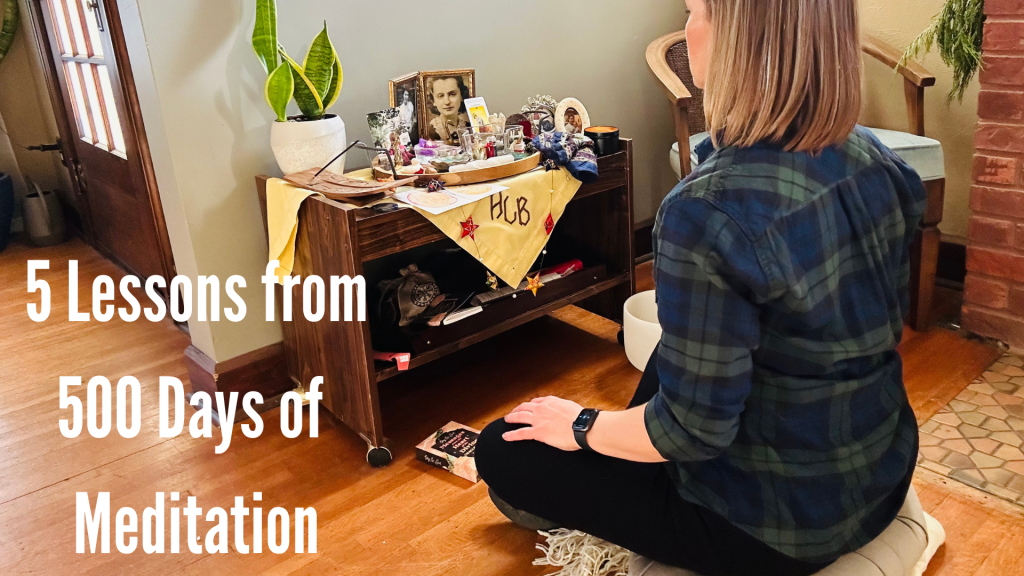
I’ve been waiting to write about meditation. First, I passed the point of 100 consecutive days, and though the benefits of the daily practice were practically bursting out of me, I thought that 100 days wasn’t impressive enough. I’ll share at the one year mark, I thought.
The one year mark came and went amidst a lot of chaos, chaos that was softened by leaning heavily on my meditation practice. But with no time to write about it.
But on December 12, 2023, I hit 500 days of consecutive meditation practice!
Mindfulness meditation practice has made a huge impact on my life, but I’m going to boil what I’ve learned over 500 consecutive days of meditation down to 5 lessons.
- Be Your Own Biggest Cheerleader. If there is one biggest impact that mindfulness meditation practice has had on my life, it’s this. I spent decades of my life beating myself up. Whether it be harshly judging my actions and/or my appearance, or comparing myself to others, I was not nice to me. But in meditation practice, there’s an opportunity to change that running narrative. Sometimes people think that meditation is about being able to concentrate for a certain amount of time without being distracted, so they think they “aren’t good at it”. But meditation is about recognizing when your mind wanders, and gently, with kindness toward yourself, bringing your attention back. That sense of kindness toward myself… replacing the “Katie, you suck at this” with “That’s okay! Just bring your attention back!” seeped into the rest of my self-talk. Over time, I’ve gone from my own worst critic, to my own biggest cheerleader, and the cheer is: “It’s okay! Keep going!”
- Show Up for Yourself. Sometimes self-care is described as “putting on your own oxygen mask first”, which is apt, especially if you frequently put the needs of others above your own, or are pouring from an empty cup. But the truth is that service to others isn’t the only reason that we don’t give ourselves the self-care we need. Stress and overwhelm can make us forget about our true capacity to show up for ourselves. We may also forget that showing up for ourselves doesn’t have to mean finding an hour to take a yoga class, or a twenty minute meditation. My teacher, Fleet Maull, taught that in mindfulness, we must “take our seat”. That may mean taking our seat on an actual meditation cushion, but it also just means showing up, and arriving at your practice. The secret is that even if you just show up for yourself for one minute, or five minutes, “It’s okay!” (see above).
- Just Breathe. Our breath is so important. When we can control nothing else around us, we can control our breath. And while we’re lucky that we don’t have to think about each breath we take, our bodies SAVOR the intentional assistance with our breath. There is a lot of anatomy and neuroscience behind breath work, and why it’s so effective, but I’m not going to rehash that here. But I joke as I’m teaching breath work, yoga, mindfulness, meditation, and other resilience practices to public safety personnel, “Have you noticed that we are mostly just breathing?!” As you read this sentence, take three big, deep breaths. Then notice how you feel. Your body and mind will thank you.
- Actively Direct Your Energy. This might tie with softening my self-talk for the biggest impact that mindfulness has had on my life. Or they just go hand-in-hand. It’s pretty simple, actually. We can passively let life happen to us, or we can make choice after choice after choice to spend our energy on the things that are important to us. But first, it helps to be crystal clear about what’s important to you. Make a list. Mine is something like: family, friends, my dog OkeDoke, my personal health and self-care, my work, my hobbies (like climbing and teaching), serving my community, my relationship with God, and all people, beings, and things. Then make another list. What gets in the way of those things that are important in your life? We practice mindfulness meditation not so we can qualify for the Best Meditator Ever Award, but so we can strengthen our muscle of mindfulness – that noticing of when our mind has wandered, and gently bringing it back – so that we can live our lives with our energy and attention directed at the things that really matter. Recognize what distracts you (phones, meaningless drama, bad habits, etc.), and direct your attention and energy back to the things on this first list. And guess what! If you get distracted, and have to start over, “It’s okay!”
- You Can Always Start Again. As the Japanese proverb, and many other iterations go, “Fall down seven times, and get up eight.” Whether you’re directing your attention during a five minute guided meditation practice, or implementing a new self-care routine, it doesn’t matter how many times you have to start over, as long as you start over. It’s totally okay.
Bonus: Some of my favorite authors, like Gretchen Rubin and James Clear, write about “habit stacking”, one of the most useful methods I’ve used to implement healthy habits. So while I hope to have convinced you to consider adding a mindfulness meditation practice to your life, think about what you are already doing. Do you pull into a certain parking spot each day? Stack a 1 minute mindfulness practice onto parking. But another option is this: Stack your mindfulness practice with a gratitude practice and/or prayer. They go hand in hand. And I won’t promise much, but I’ll promise this. You’ll never regret taking three big breaths and listing three things you are grateful for.
Start small, folks. My meditation practice took many years, many 21 Day Challenges, many courses, many articles, many apps, and a 300 Hour Meditation Teacher Training to develop – not to mention the past 500 (!) days – and I get distracted during meditation ALLLLLLL THE TIME. I’m always interested in deepening my practice, including extending the length of the practice. But the current length (about 20 minutes daily, followed by gratitude and intention setting) is one that fits well into my morning routine, and is something that I can maintain. It’s been encouraged that I participate in annual silent mindfulness meditation retreats and everything inside of me pouts, “But I don’t wanna”. My practice has lots of room to grow, but for now, it is where it is and that’s okay.
I’m endlessly grateful for the people and organizations who have helped me develop this practice. It started with the Center for Mindfulness in Public Safety, including my teachers and friends Dr. Fleet Maull, Vita Pires, John MacAdams, Julie Paquette, and Robert Ohlemiller. I completed my 300 Hour Mindfulness and Meditation Teacher Training through the Engaged Mindfulness Institute, with the same amazing people listed above.
 By Katie Carlson